
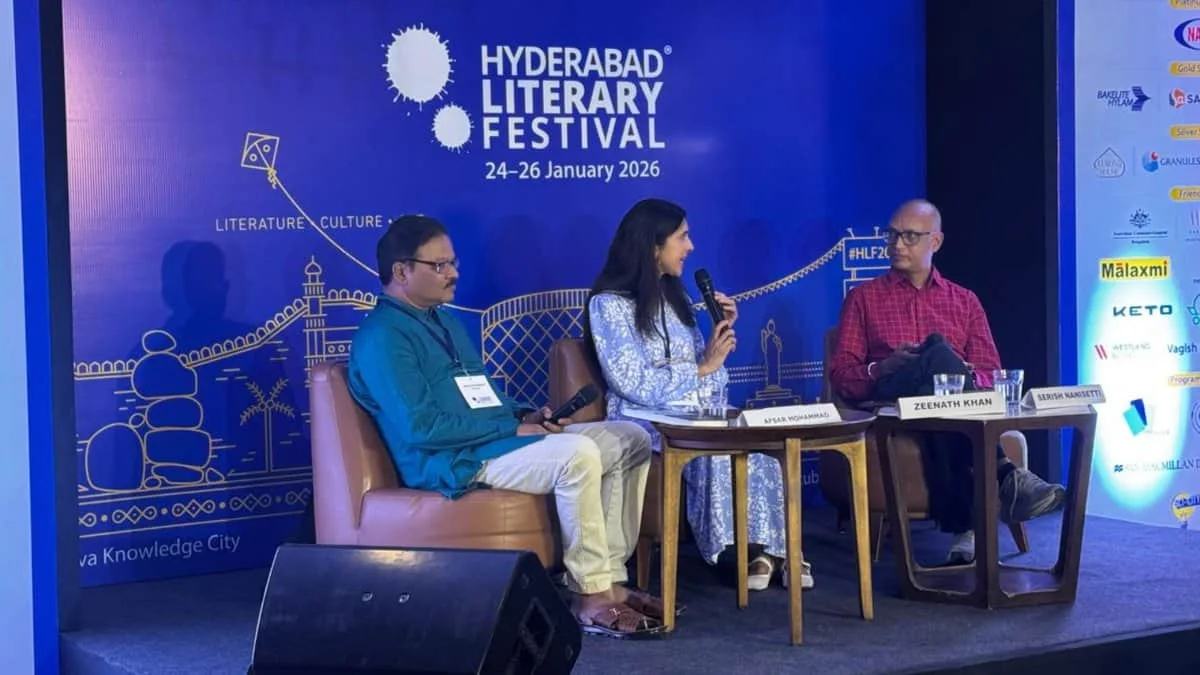
Hyderabad: As many as 50,000 Muslims were killed and nearly 100,000 migrated to other parts of the world after the 1948 police action in Hyderabad, which led to its annexation to India, claimed author and historian Afsar Mohammad, adding that the violence affected the pluralistic nature of the region.
Speaking at Day 2 of the Hyderabad Literary Festival on Sunday, January 25, in a panel discussion titled “Hyderabad, September 1948,” along with writer Zeenath Khan, Mohammad said that much of what happened in the dreadful five days of violence from September 13 to 17, 1948, is lost in history.
Mohammad, an internationally acclaimed and award-winning South Asian scholar working on Hindu-Muslim interactions in India and a faculty member at the University of Pennsylvania in Philadelphia, spoke about his journey of writing his book, “Remaking History: 1948 Police Action and the Muslims of Hyderabad.”
“For my research, I dug through archives extensively, but I did not find anything. There is nothing about the police action,” he said, as the material remains confidential.
“I had to depend on witness testimonials for my book, even as most people were scared to talk about it. After I heard the audio recordings, it took me a while to write about it as it was traumatic to hear,” Mohammad said.
He said he started getting calls to write about the topic, especially after 90 out of 150 people who witnessed the violent takeover of Hyderabad by the Government of India died from COVID-19.
“A lot of memoirs were published in the Urdu media, especially the Siasat newspaper. I had to create an alternative archive and reconnect the history as there was almost no information out there,” Mohammad said.
Turning to fiction to make the incident relatable
Khan, on the other hand, spoke about how she turned to fiction writing in her debut book, “The Sirens of September.”
“When I read in detail about the police action, I thought it would make a great novel. There’s a lot of coverage on the partition of India in the north, but a neglect in the coverage of events in South India in general,” she said.
Khan said that she wanted her readers to relate and “if I wrote it as a story, people will relate more.”
“When writing fiction, I can fill in the gaps where there is no information with imagination. What I couldn’t find [on the police action], I recreated,” she said.
Mohammad said in new histories, the line between reality and fiction is very thin. “In traditional history, we ignore the actual experience of the people. In the 1948 police action, both the Hindu and Muslim communities experienced the rapture,” he said.
“Having testimonials before me helped me analyse the chain of events of September 1948. We need to care about the experience of the people,” he added.
The panel discussion at the literary festival at the Sattva Knowledge City in Hyderabad’s Hitec City was moderated by journalist Serish Nanisetti.