
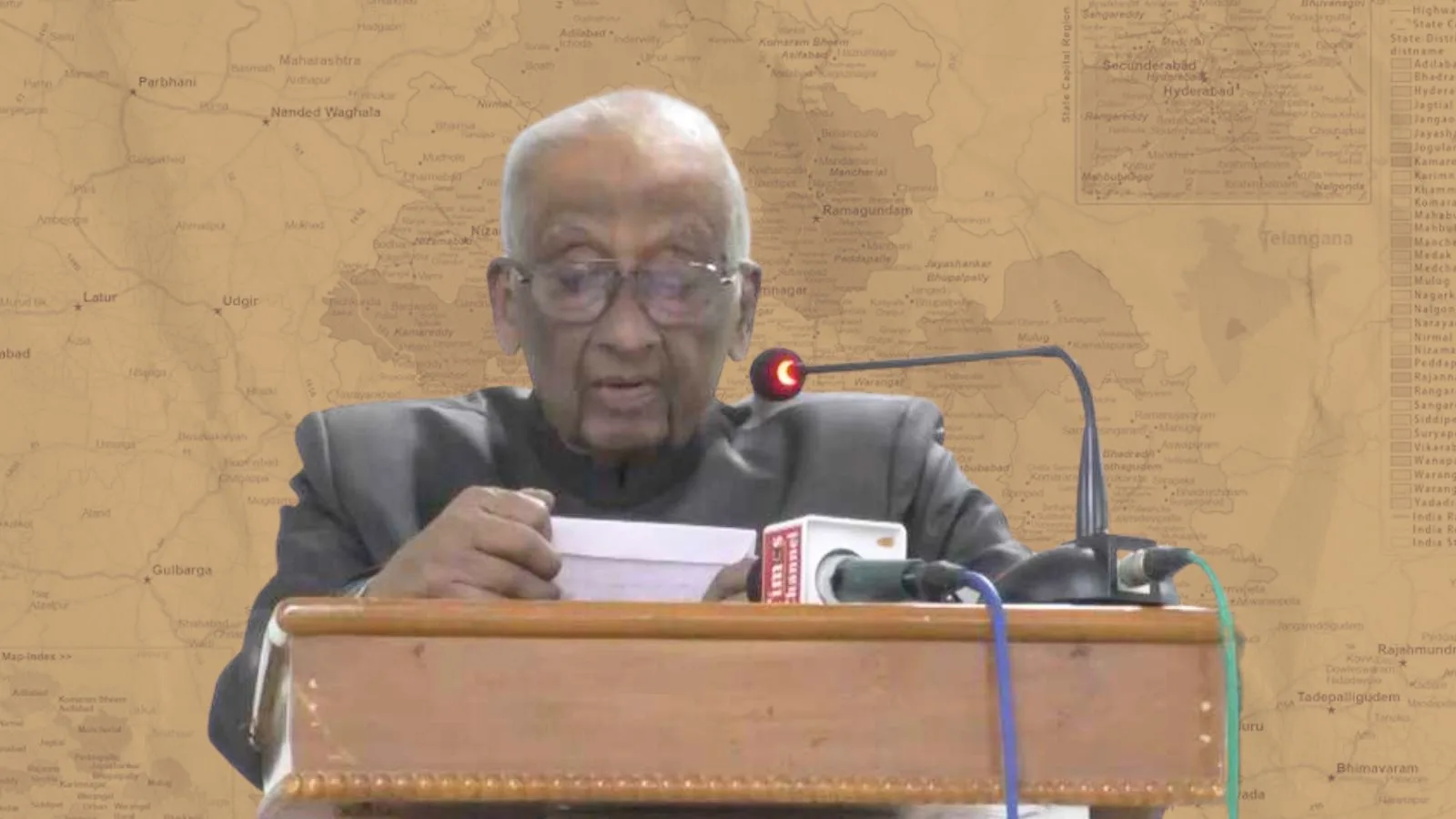
Sometimes, it is difficult to write about a person one is familiar with. I find myself in this very predicament while sitting down to pen these lines on former Law Minister Asif Pasha, who passed away on December 28. Death transforms someone you know into someone you knew — a truth that feels painfully real today.
I was with him just a day earlier, on December 27, when he felicitated Faizan Zaki, the young prodigy who won the Scripps National Spelling Bee Championship in the United States. At 96, Pasha appeared remarkably healthy, alert and spirited. He had come to the MediaPlus office at Gun Foundry to collect a copy of his much-awaited autobiography, No Regrets.
Holding the book in his hands, he gently flipped through its pages — as if rewinding the many chapters of his life — and smiled. He even posed for a photograph, proudly clutching the book, before leaving for home, eager to read it at leisure.
The following day, he called me to say the book was “okay” and that he wished to discuss a few things. That conversation never happened. Around 10 pm, the shocking news reached me — Pasha was no more. I could hardly believe it. Just two days after turning 96, a man who was planning a formal launch of his biography had quietly slipped away.
That, perhaps, is life in its most unforgiving form.
Though he had been undergoing treatment for a heart ailment and was in and out of the hospital, few imagined that he would not live to see his life’s story formally unveiled. Some departures come without warning, leaving us utterly unprepared.
Pasha never fitted the stereotype of a self-serving politician. He remained grounded, unassuming and deeply committed to public life. Unlike many of his contemporaries, he neither chased power nor lamented lost opportunities. A one-time minister, his tenure was extended during the Emergency in the 1970s. After losing the subsequent election, he chose never to contest again.
When the Congress party split in 1978, following internal turmoil and the formation of the Indira Congress, Pasha aligned himself with the Brahmananda Reddy–Vengal Rao group, which later merged with the Congress faction led by Devaraj Urs. The electoral rout that followed sealed not only the fate of that group but also marked the end of Pasha’s active political career.
An alumnus of the Aligarh Muslim University, Pasha graduated in law with first-class honours. His early ambition was to become a judge, but he was not selected as a Munsif Magistrate by the Andhra Pradesh Service Commission headed by Ghulam Hyder.
Years later, fate played an ironic hand. When Pasha became Law Minister, Ghulam Hyder once called on him regarding a legal matter. Pasha instantly recognised him, though the recognition was not mutual. When reminded of the rejected application, Hyder famously remarked, “You should thank me. Had I selected you, you would have been a magistrate in some remote corner. Today, you are a minister for the entire state.”
Hailing from the influential Lal Imli family of Vijayawada, Pasha shared an unusual childhood bond with the legendary NT Rama Rao. After school hours, the two played football together at the Municipal High School grounds — long before NTR went on to become Chief Minister. Yet, when NTR rose to power, Pasha did not attempt to join the Telugu Desam Party. In fact, he offered to resign from the Minorities Commission he was heading. NTR declined the resignation and asked him to continue.
Interestingly, even after ceasing to be a minister in 1978, Pasha did not seek political rehabilitation in subsequent Congress governments. His lone attempt at electoral comeback — contesting the Nandyal parliamentary seat — was unsuccessful. Despite having access to influential figures such as Mohammed Yunus, Indira Gandhi’s special envoy, he never leveraged those connections for personal gain.
Asif Pasha had the distinction of being the first Muslim minister from undivided Andhra Pradesh. Though his ministerial career lasted just one term, he enjoyed close ties with several national leaders. Prime Minister Indira Gandhi laid the foundation stone for Dr Zakir Hussain College in Vijayawada, established by the India Education Trust, of which Pasha was a key member.
Known for his organisational acumen, Pasha successfully hosted the All-India Muslim Educational Society (AIMES) conference in 1976, inaugurated by then President Fakhruddin Ali Ahmed. A grand mushairaorganised at King Koti as part of the event was attended by the legendary actor, Dilip Kumar, and his wife Saira Banu.
As Secretary of the HEH Nizam’s Trust, Pasha was closely associated with Hyderabad’s royal family. Though he served as Law Minister, it was his father-in-law, Abdul Sattar Ghatala — a former peshi secretary to the seventh Nizam — whose deep connections provided him access to the inner circles of royalty. Over the years, Pasha maintained close ties with Nawab Kazim Nawaz Jung, Moazzam Jah Bahadur, Shahzadi Pasha and later with Mukarram Jah and Muffakham Jah Bahadur. In recent times, he remained in touch with Princess Esra and Azmet Jah Bahadur, the ninth head of the Asaf Jahi dynasty.
A man with a keen interest in travel, Pasha visited several countries, including Australia, Singapore, Malaysia, the UAE, Syria, Iraq, Saudi Arabia and Pakistan.
In the twilight years of his life, he remained active, associated with institutions such as the Nizam Trust, AIMES and the Aligarh Club, and continued to champion socially beneficial causes. In 2019, the Telangana government honoured him with the prestigious Maulana Abul Kalam Azad National Award.
On December 29 afternoon, Asif Pasha was laid to rest at the graveyard adjacent to the Qutb Shahi Masjid in Mehdipatnam, in the presence of family members and well-wishers.
As someone once said, to live in the hearts we leave behind is not to die. Asif Pasha lives on — not in power or position, but in memory, dignity and quiet grace.