
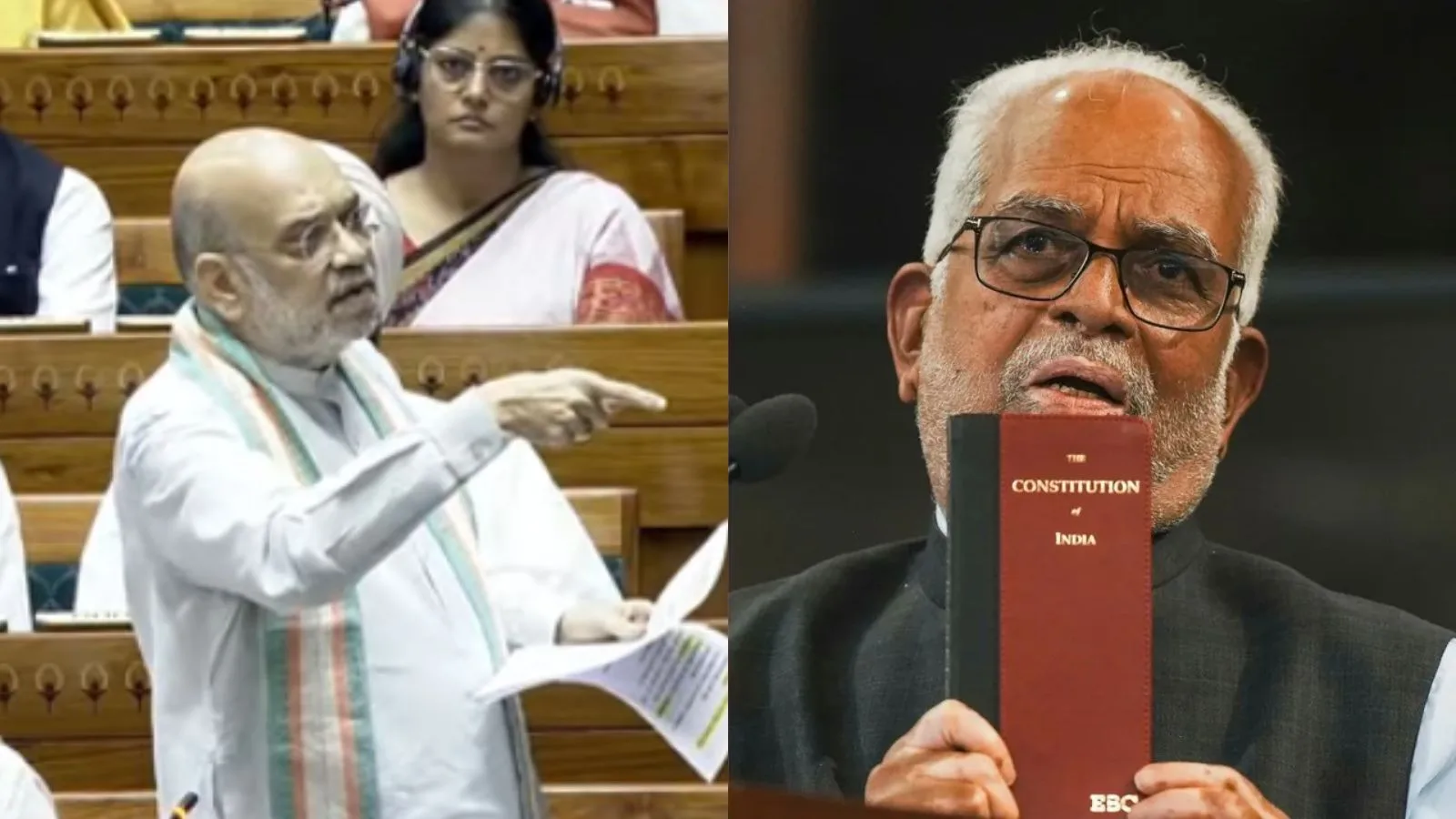
Hyderabad: People’s organisations and activists in Telangana strongly condemned Union Home Minister Amit Shah’s remarks in the recent Parliament Session, against the 2011 verdict delivered by former Supreme Court Justice B Sudershan Reddy against the use of ‘Salwa Judum‘ (Special Police Officers) to eliminate the Maoists during the United Progressive Alliance (UPA) government.
Amit Shah had not only condemned the judgment but also accused Justice Reddy of using his personal ideology to wrap the case with constitutional provisions and delivering the verdict, which he said emboldened the Maoists further, to eliminate all those who were linked with Salwa Judum.
He had also criticised the Congress for fielding Sudershan Reddy as the contender for the post of Vice-President of India last year.
“Those who believe in the law of the land will not propose such a candidate for the top constitutional post,” he had remarked, continuing his tirade against the Congress, holding the party guilty of all the murders perpetrated by the Maoists, and depriving the Adivasis of the fruits of development for all these decades.
The Union Home Minister’s remarks against Sudershan Reddy, who hails from Telangana, did not go well with the activists here, who felt that Shah’s statements were not only contempt of the apex court but a misuse of his parliamentary privileges.
During a round-table meeting held at Sundarayya Vignana Kendram in Hyderabad on Saturday, April 10, advocates, judges, professors, and activists voiced their opposition to Amit Shah’s views and demanded accountability from a person holding the office of the Home Minister for making such statements.
Former AP/Telangana High Court Justice T Rajani said that Shah’s words violated Article 121 of the Indian Constitution, which restricts discussions in Parliament regarding the conduct of Supreme Court or High Court judges in the discharge of their duties. It prohibits parliamentary debate on judicial actions, except during the impeachment proceedings to remove a judge.
Professor D Narasimha Reddy saw Amit Shah’s statements as a systematic pattern to create an atmosphere of fear in society.
“A narrative is being built by keeping the media in control, where a home minister says such things in the Parliament, and then the whole country is made to listen. He also used the term ‘urban naxals’ to link people with them (Maoists). Perhaps that term will be used against all people like us. Such narratives have now penetrated into society even without our knowledge,” he felt.
Telangana Jana Samithi (TJS) President Professor M Kodandaram saw Shah’s remarks as an attack on judicial autonomy, aimed at threatening to work as per the whims of the State.
S Jeevan Kumar from Human Rights Forum (HRF) said that such attacks on the judiciary have happened in Poland, Hungary, Israel, Turkey, and are currently underway in the United States.
Veekshanam Editor N Venugopal referred to the hue and cry raised recently on the chapter ‘Corruption in the Judiciary’ in the NCERT textbooks, which escalated all the way to the Prime Minister’s office and was removed.
“The chapter’s contents were from a speech delivered by former Chief Justice DY Chandrachud. The books have been banned. This is how atrocious the Supreme Court has become,” he opined.
Also claiming that Attorney General Tushar Mehta has been crossing his line and calling the shots in the Supreme Court, Venugopal pointed out how the former said the other day that constitutional morality was a myth.
“The Supreme Court is forgetting its responsibility by still remaining silent,” he said.
He also condemned Amit Shah’s comments against the National Advisory Council (NAC) that was constituted by former Prime Minister Dr Manmohan Singh, which was comprised of urban naxals. He reminded that the NAC was headed by the then UPO Chairperson Sonia Gandhi.
K Sreenivas Reddy, Telangana Press Academy Chairman, spoke about how different institutions were being weakened, giving the example of the Press Council of India, which is a quasi-judiciary authority.
He said that though the term of the 14th Press Council had ended more than 1.5 years ago, till now, the 15th Press Council has not been constituted. But now they (Centre) constituted it without the representation from the working journalists.
The participants of the round-table meeting believed that the Bars of various courts needed to discuss these developments, and that judges needed to take a stand on what has been happening in the country.