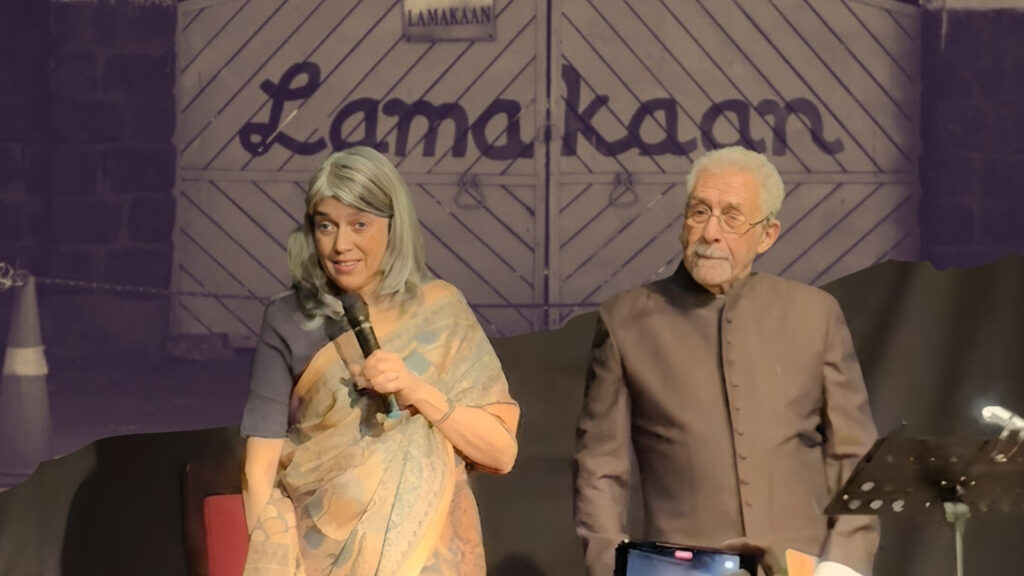
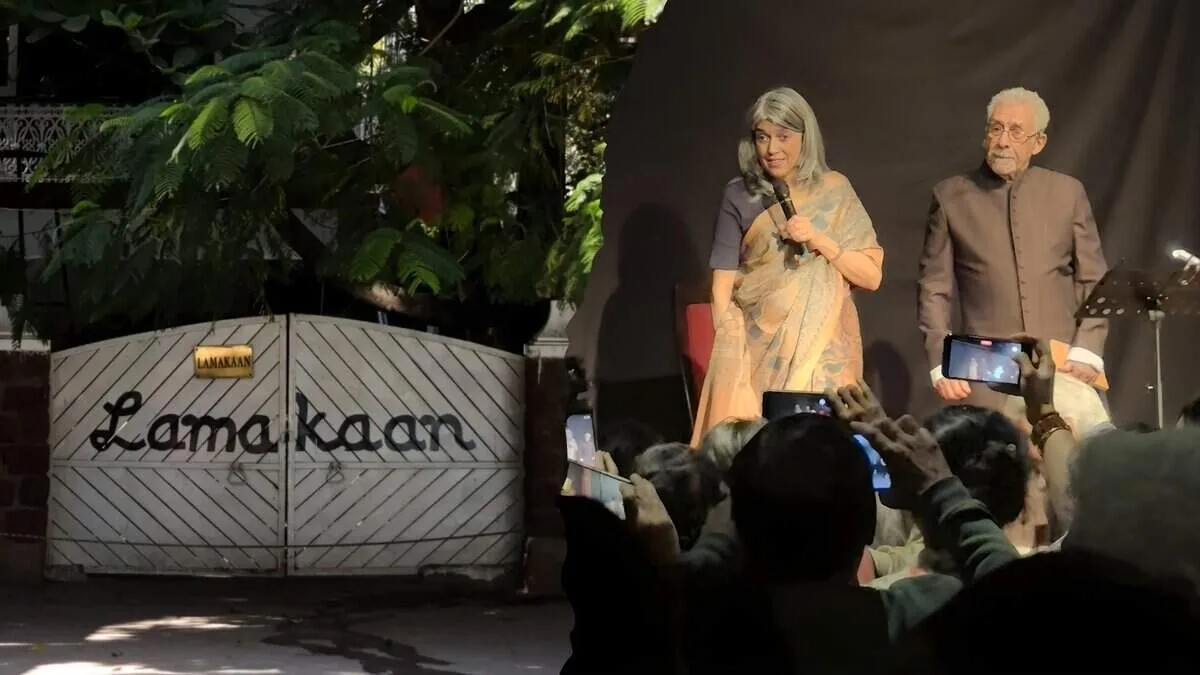
“Naseer bhai Hyderabad ke damaad hain, (He is the son-in-law of Hyderabad),” was how Lamakaan’s co-founder, Elahe Hiptoola, introduced Naseeruddin Shah for the opening session of Lamakaan’s 16th anniversary celebration.
The humble makaan was packed to the brim on Thursday, February 5, with people even climbing on the boulders. All this effort, just to get a glimpse of veteran Bollywood actor Naseeruddin Shah and the performance that was going to follow.
“It is through my connection with Ratna Shah that I know Naseeruddin Shah. Our families go way back, as our fathers have worked together. So, when I invited Naseer bhai to Lamakaan, he said- main aaunga magar mere kuch shart hain (I will come, but I have some conditions). He sent me a text saying- main aaunga, but on the condition that you feed me bagare baigan, tamate ka cut, talawa ghosht and qubaani ka meetha,” Elahe continued.
It was settled, Hyderabadi food shall be served, and Naseeruddin Shah shall come. The condition, met with laughter and applause, set the tone for the intimate nature of the evening.
Man of the hour
In true Naseeruddin style, the actor walked on the stage without any elaborate preface, dressed in a simple brown sherwani. He came with a humble request, to not witness him via mobile screens, and Lamakaan’s courtyard settled into collective attentiveness.
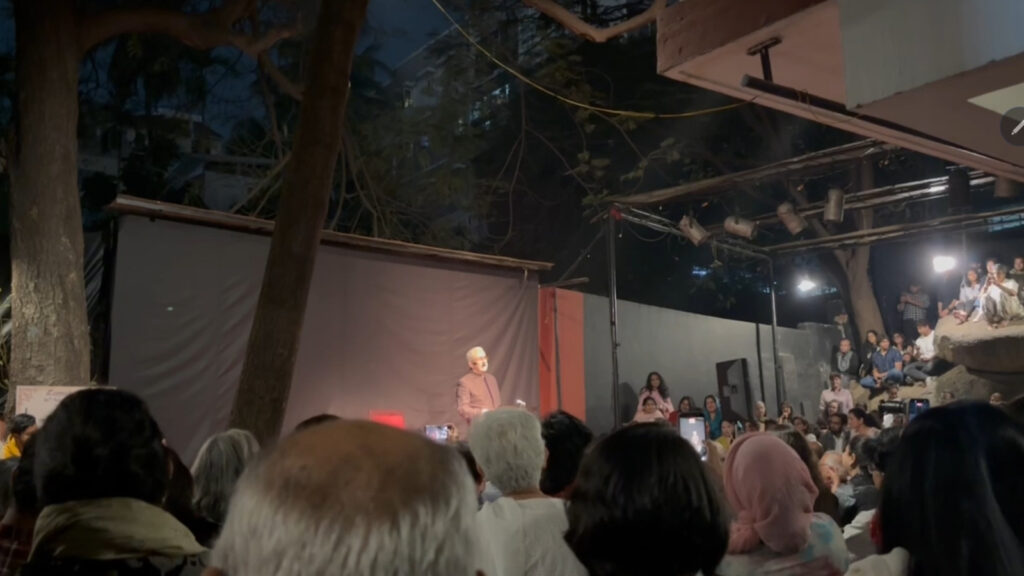
“I have always loved students. When I am around students, I truly feel young again,” Naseeruddin started, “So when I was invited to Mumbai University’s Jashn-e-Urdu, I was very happy. However, on the night of 31st January, I was asked not to come. I was disinvited, and I felt like a bin bulaaya mehmaan kisi ke shaadi main ghus aaya hoon. Baraat waale samajhte hain main dulhan ki taraf se hoon, and dulhan waale samajhte hain main baraat ki taraf se hoon (I felt like an uninvited guest at a wedding).”
He said he believed he was disinvited because the university assumed he might say something controversial, or itni Urdu bolunga ki kisi ki samajh nahi aayegi. Referring to the episode with humour, Shah remarked, “Toh jo azaab main Mumbai University par naazil karna chahta tha, maine socha Hyderabad par naazil kar doon (The wrath that I wanted to bring down upon Mumbai University, I thought I’d bring it down upon Hyderabad instead).”
An evening of reflection
Naseeruddin Shah opened Lamakaan’s anniversary session with Allama Iqbal’s Sair-e-Falak. Before the first verse, he shared a rare personal insight, noting that the poem aligns deeply with his own worldview. As he spoke of the celestial journey, his voice carried the weight of a man reflecting on his own place in the universe.
He then moved from the cosmic to the deeply social, introducing Faiz Ahmad Faiz’s nazm, Dua. He paused to offer a poignant clarification: “Yeh dua unhone apne liye nahi maangi, yeh dua poore insaaniyat ke liye hain (Faiz did not make this prayer for himself, this prayer is for humanity).”
Hum jinhein rasm-e-dua yaad nahi…
This emphasis on universal empathy felt like a quiet, political rebuttal that Naseeruddin Shah is famous for.
Between casual sips of chai, he recited Sahir Ludhianvi’s Taj Mahal, a biting critique of power masked as love:
Ik shehanshah ne daulat ka sahaara lekar
Hum gharibon ki muhabbat ka udaaya hai mazaak
The tone turned somber as he spoke of Faiz’s 1951 imprisonment, where the poet was denied even pen and paper. Reciting Zindaan ki ek Shaam in the free air of Lamakaan, he reminded the crowd that thought cannot be caged. This was followed by Sahir’s Mere Geet and Faiz’s Mauzu-e-Sukhan, exploring why artists must speak on social pain rather than just beauty, a mirror to Shah’s own recent outspokenness.
A masterclass in comedy: Chacha Chakkan
After the heavier pieces, it was time for the main event: a reading of Imtiyaz Ali Taj’s Chacha Chakkan ne Khat Likha. This was where the veteran actor truly took centre stage. The atmosphere turned electric as Naseeruddin seamlessly shifted between characters.
With just a change in tone and posture, he brought to life the bumbling, hilarious Chacha, the sharp-tongued Chachi, and even the frantic letter carrier. The audience erupted in laughter as they watched a master of his craft turn a simple reading into a vivid, multi-character theatrical experience.
A graceful exit
To close the evening, Naseeruddin returned to the timeless philosophy of Mirza Ghalib. He recited the profound Na tha kuch toh Khuda tha, leaving the audience with words that echoed long after he finished:
Na tha kuchh to khuda tha, kuchh na hota to khuda hota
Duboya mujh ko hone ne, na hota main to kya hota