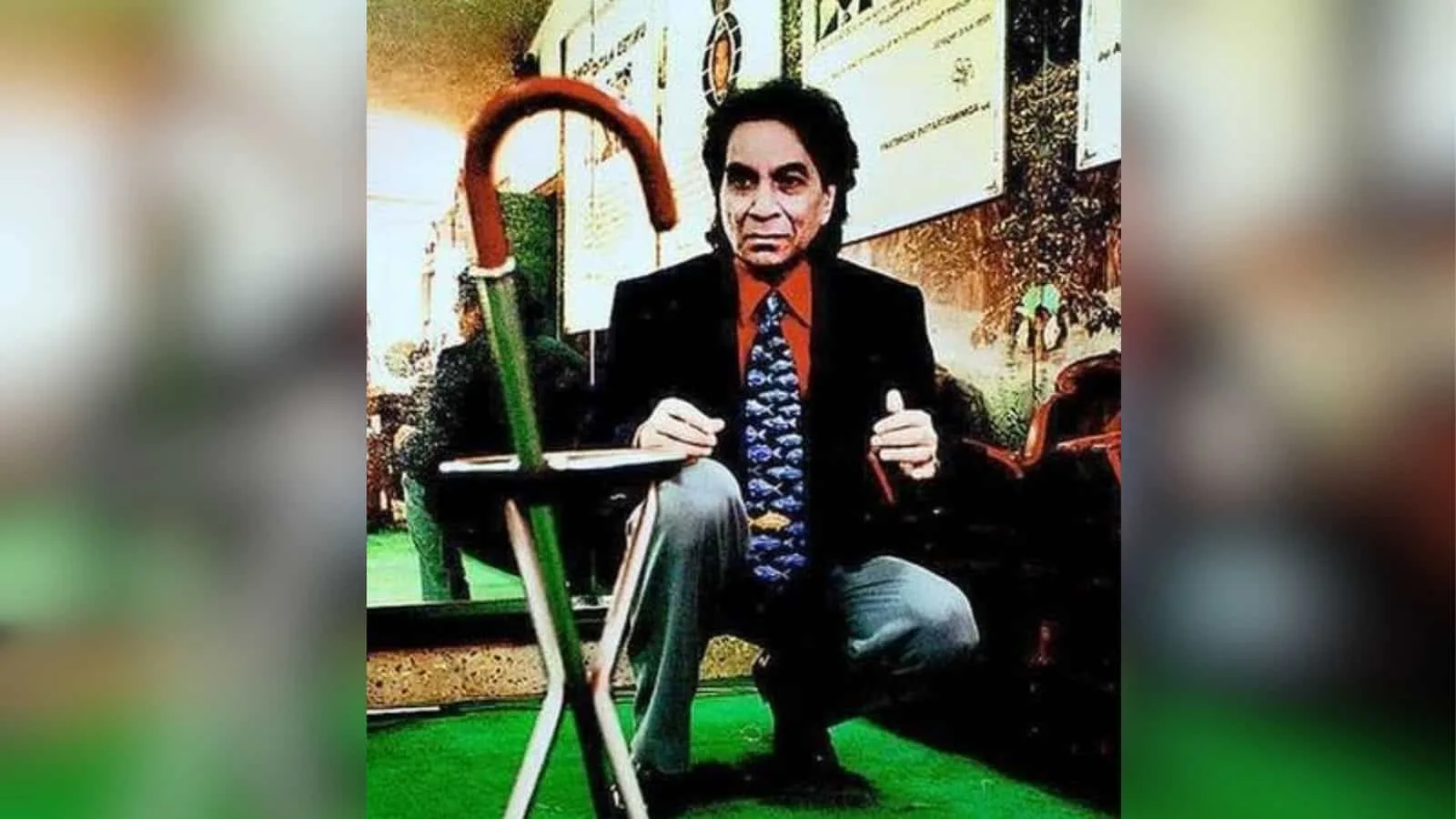
Jokes aside, it is time to turn serious. The man who brightened dull evenings and brought smiles to weary faces is no more. Babban Khan, the king of comedy, has passed away, drawing the curtain on one of the most celebrated and longest-running shows, Adrak Ke Panje.
He breathed his last on Friday night, April 17, after a brief illness. He is survived by his wife, Shaila Khan, and their two daughters. The mortal remains of the showman were laid to rest at a graveyard in Hyderabad’s Shantinagar on Saturday, April 18.
Baba aaye, baba aaye…
Arey chup. Main daftar se aaroon, jail se thodi aaroon.
Who can forget these iconic lines? They once echoed across packed auditoriums, defining an era of humour that was uniquely Hyderabadi. Those echoes now belong to memory.
For 35 remarkable years, Adrak Ke Panje reigned supreme as one of the longest-running one-man shows in the world. From September 22, 1965, to February 11, 2001, it clocked an astonishing 10,000 performances across 60 countries in 27 languages. In sheer scale and endurance, it surpassed global stage legends like The Mousetrap by Agatha Christie and Broadway sensation A Chorus Line.
What made the feat even more extraordinary was its simplicity. No elaborate lighting, no music, no changing sets – just raw performance. The stage could be set in 17 minutes and cleared in 10. The entire production cost a mere Rs 650. Even seasoned theatre personalities like Rex Harrison were astonished by its minimalism.
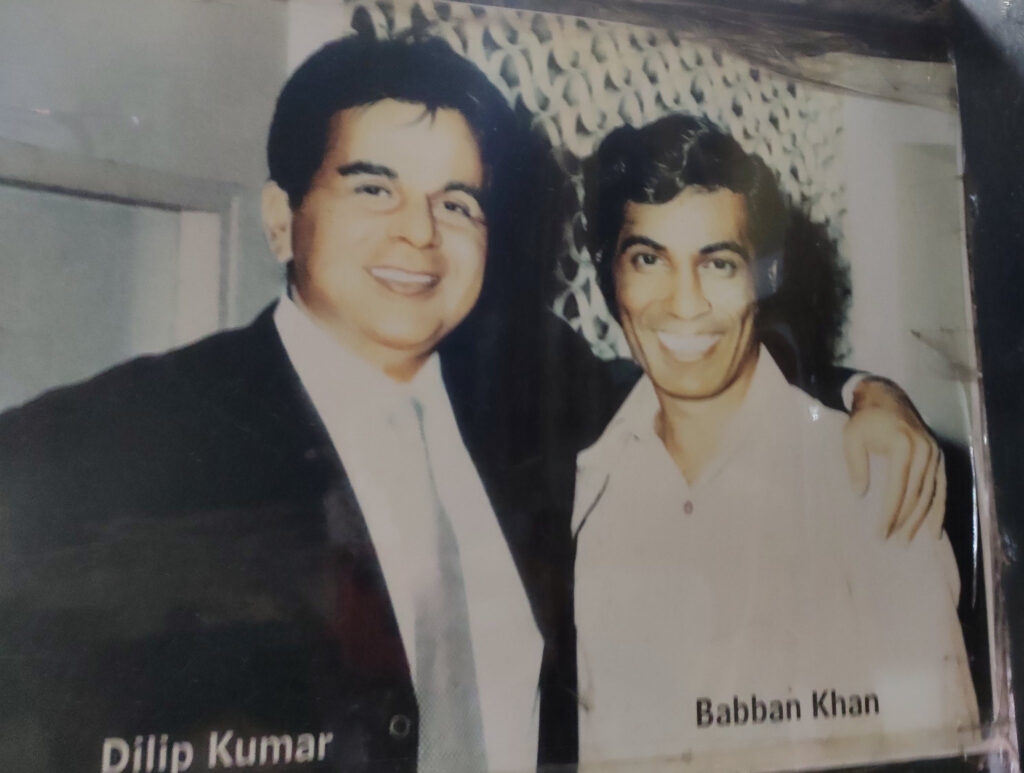
From the bylanes of Hyderabad to global stages across America, Russia, London, Tokyo and beyond, the play drew packed audiences. It even entered the Guinness Book of World Records in 1984. Recognition poured in from prestigious institutions worldwide, and admiration came from towering figures such as Margaret Thatcher, Nelson Mandela, Queen Elizabeth II, Indira Gandhi, Frederick Forsyth and Francis Ford Coppola.
Didn’t he feel bored performing the same play for so long? “No, never. It has become part of my life,” Babban Khan told this writer once. His wife, Shaila, and daughters Nazneen and Zareen also formed part of the cast.
The secret sauce
What’s the secret of the play’s continued appeal? The universal issue of family planning it addresses and Khan’s foresight in highlighting the consequences of an unplanned family long before it became a problem. Of course, the punchy Dakhni one-liners and the way they are articulated are also a major reason for its super success.
This comedy is actually born out of tragedy. The satirical play mirrors the trials and tribulations faced by the writer’s parents because of their large family. His father, Ghouse Khan, a lowly paid clerk in the Fire Service Department, was caught in such financial straits that one after another he lost his three sons and four daughters to malnutrition and lack of medical care. Shocked by these sad events, the only surviving child was not given a name till the age of 10, lest death claimed him too.
They just called the boy “Babban,” not knowing that this name would bring them luck and fame beyond their wildest dreams. Young Babban never forgot the hungry days, the sleepless nights, the tears and troubles. He still remembered the problem faced by his parents in paying the rent of Rs 1.75 paise for House no 24 at Charkhandil in Aghapura.
It was on August 15, 1965, that Babban Khan sat down to write the magnum opus under a street light, since there was no electricity at his house. His own family life and personal experiences came in handy to write the play. It took him a little more than three hours to script Adrak Ke Panje, which changed his life forever.
When the play was ready, he had no money to stage it. He sold the gold pendant of his mother, Sughraunissa Begum, for Rs 275. Out of this amount, Rs 200 went towards booking the Ravindra Bharathi auditorium, Rs 18 for sherwani cloth, Rs 2.50 for umbrella, Rs 30 for printing tickets and with the remaining money, he bought ration for his house. There was no money to pay the tailor. He was instead given a free pass for the show.
For 15 years, Babban Khan’s mother thought he was doing some business. When she watched the show, she couldn’t understand what her son was doing to make people laugh.
Babban Khan’s first show was a flop
When the first show was staged on September 22, 1965, Babban Khan was a bundle of nerves. Though financially it was a flop, the audience enjoyed it thoroughly. Encouraged, he borrowed Rs 500 from friends and presented a second show at the same auditorium. This time, it was a roaring success. The rest, as they say, is history.
Like the classic dialogues of the blockbuster Sholay, the dialogues of Adrak Ke Panje have become timeless. Sample some famous lines:
Jockey (neighbour): Hud ho gayi tumhare bacchon ki shararat aur badtamizee ki.
(There is no end to your children’s nuisance and insolence)
Babban Khan: Bacche hain badtamizee karte, kaisi baat karre aap?
(Children do act mischievously. But, why you take it so seriously?)
Jockey: Parsoon main apne makan ke gate ke paas baitha tha. Ye jaante huye ke main khud kutte ke saath moujood hoon, aapke baccha pathar lekar mar diye – jiski waje se kutta sakht zakhmi hogaya.
(The other day, I was sitting with my dog. Knowing fully well that I am with my dog, your son threw a stone, seriously injuring it)
Babban Khan: Main maafi chahta hoon bacche ke nishana ghalat ho gaya hoga.
(I am sorry. Perhaps the boy missed his target)
Sample another.
Money lender (Lala Gulazari Khan): Abhi tumhare makan ko araha tha ek lorry wala takkar de diya. Agar zara hota to hum mar jata tha.
(As I was coming to your house, a motorist almost hit me. But for a split second’s delay, I would have died)
Babban Khan: Agar zara hota to aap mar jate the. Arrey wo zara kyun nai huwa.
(I really feel sorry for that split second’s delay).
And now sample some more.
School master: English aur mathematics ko chodo – drawing mein ek ulloo ki photo utarne ke liye kaha to aapka baccha photo tak utar na saka.
(Leave alone English and mathematics, when I asked your son to draw the picture of an owl, he couldn’t)
Babban Khan: Hamare Chunnu tumhare ko ulloo ki photo utarne nai aata?
(You can’t draw the picture of an owl?)
Son: Nai aata.
(Can’t do).
Babban Khan: (Pointing towards the school master) Kambakhat saamne dekh kar nai utar sakta?
(You wretched! Can’t you just see in front of you and draw?)
In one of his fonder moods, Babban Khan buys a jar of cold cream for his wife. She protests, “Is this the age for me to apply cold cream?” To this, Khan replies, “My dear, only when a shoe becomes old, does it require some polishing.”
Enthralling all
These tongue-in-cheek remarks have become part of Hyderabadi lore. They combine both logic and laughter. Audience reaction to the play has varied over the years. Some giggled, some laughed and a few turned teary-eyed at the sad situations from which humour is drawn.
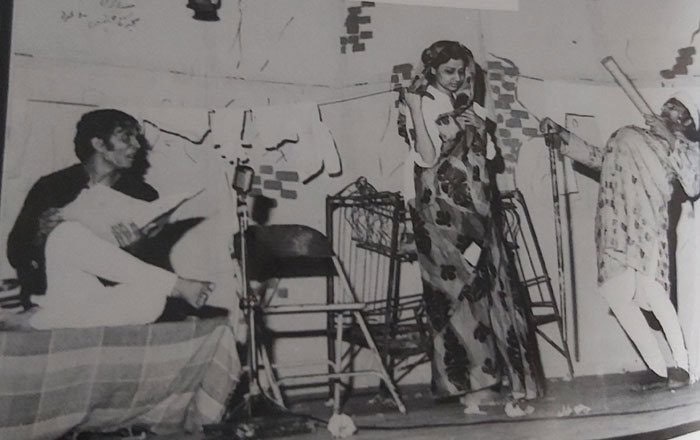
Ramtoo’s house in the play is a picture of chaos. Empty pots and pans, broken chairs, a wall clock, oil tins, a lantern and an empty bird cage.
Amidst this clutter, Ramtoo, an improvised clerk, takes potshots at life. His wife has a litany of complaints – children’s school fees, milkman’s dues, grocery and house rent. There is also an unending stream of angry creditors, guests and eccentric relations to contend with. However, an unperturbed Ramtoo takes all this in his stride. He keeps the audience in splits with his clever comments and sustains the show singlehandedly.
For Babban Khan, comedy was never just about laughter. It was, as he believed, “a funny way of being serious.”Today, the man is gone. But his words, his wit, and his world remain alive in memory, echoing in laughter that refuses to fade.