Hyderabad: The Telangana government has announced plans to create a third electricity distribution company — Telangana Rythu Power Distribution Company Limited (TGRPDCL) — focused mainly on agriculture and government-linked water supply services.
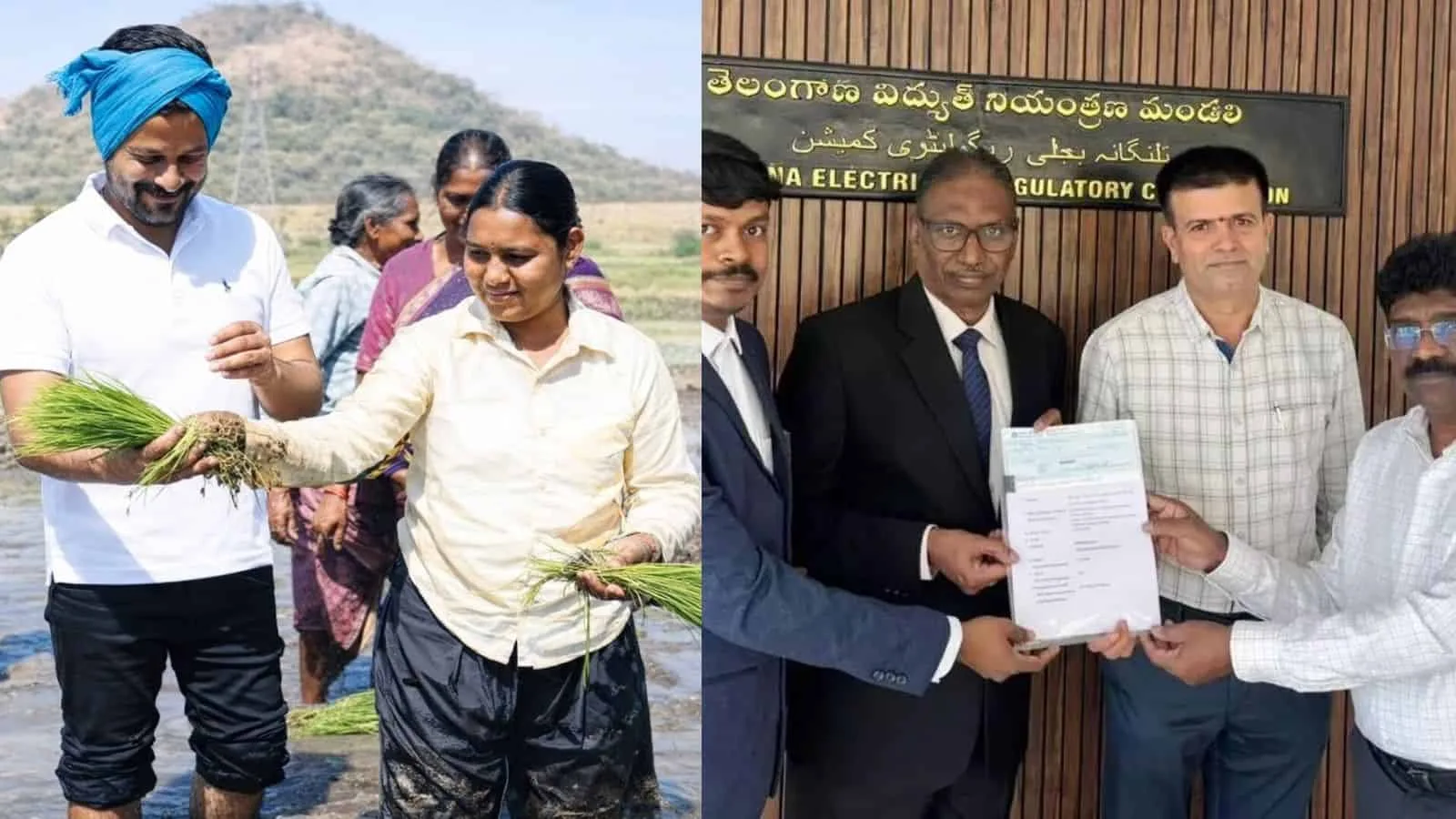
The proposal has now reached the regulatory stage, with TGRPDCL applying for a distribution licence before the Telangana Electricity Regulatory Commission (TGERC) under the Electricity Act, 2003.
The government has stated that it intends to make the proposed DISCOM operational from June 2, 2026, subject to completion of the regulatory and administrative process.
At the same time, the proposal has triggered wider political, administrative and regulatory debate, with objections, representations and support letters being submitted before the regulator by employee unions, power-sector observers and farmer organisations.
What is TGRPDCL?
Telangana currently has two electricity distribution companies:
Southern Power Distribution Company (TGSPDCL)
Northern Power Distribution Company (TGNPDCL)
The state government now wants to create a separate DISCOM focused largely on:
- agricultural power supply,
- lift irrigation schemes,
- Mission Bhagiratha and CPWS systems,
- HMWSSB connections
- and municipal water supply services under the LT VI-B category.
According to the Telangana Chief Minister’s Office, the idea is to create a specialised utility focused on rural and farm power management.
Why is the proposal unusual?
Most electricity distribution companies in India are divided geographically.
States such as Karnataka, Uttar Pradesh, Odisha and Delhi have DISCOMs structured around territorial regions.
However, TGRPDCL is being proposed primarily around a consumer category — agriculture and water-supply consumers — rather than a geographic region.
This distinction has become one of the central issues in the debate surrounding the proposal.
In submissions before TGERC, senior journalist and Centre for Power Studies convener M Venugopala Rao questioned the rationale behind creating a category-based DISCOM instead of a region-based utility structure.
While category-focused DISCOM models remain uncommon, Haryana has also recently announced plans for a separate agriculture-focused utility for farm consumers.
Has the company already been created?
Yes — administratively.
The Telangana government issued orders establishing TGRPDCL in March 2026, and the Ministry of Corporate Affairs granted incorporation approval on March 18, 2026.
Documents filed before TGERC state that the company has already obtained PAN, TAN and GST registrations and was incorporated with an initial paid-up capital of Rs 5 crore.
Senior IAS officer Musharraf Ali Faruqui was appointed Chairman and Managing Director, while directors from existing DISCOMs were inducted into the board.
So, has the DISCOM officially started functioning?
Not yet.
This is one of the main points at the centre of the debate.
While the company has been incorporated and preparatory work has started, TGRPDCL still requires a formal distribution licence from TGERC before it can legally operate as a distribution utility.
Supporters of the move argue that company formation, deputation of employees and preparatory administrative work can legally happen before final licence approval. They point out that under the Electricity Act and related rules, creation of a DISCOM involves multiple stages, including:
- company registration,
- transfer schemes,
- employee allocation,
- infrastructure planning,
- licence applications,
- public hearings,
- and regulatory scrutiny.
They argue that the final operational licence is granted only after TGERC completes its review process.
How does TGERC function?
TGERC is Telangana’s statutory electricity regulator and functions under the Electricity Act, 2003.
The commission regulates:
- electricity distribution,
- tariffs,
- licensing,
- power procurement,
- and consumer-related issues.
Any company seeking to distribute electricity in Telangana must obtain a distribution licence from TGERC under Sections 12, 14 and 15 of the Electricity Act.
The process involves:
- filing technical and financial details,
- publication of public notices,
- inviting objections and suggestions,
- public hearings,
- scrutiny of financial and operational plans,
- and finally a regulatory order granting or rejecting the licence.
Petitions, objections and stakeholder submissions are usually uploaded publicly as part of the consultation process.
In the case of TGRPDCL, the company has already been incorporated, directors and a CMD have been appointed, employees have been deputed, and preparatory administrative work has started, while the licence application is still under consideration before TGERC.
Supporters say this is a normal administrative process and does not mean the DISCOM has formally begun distribution operations. Critics, however, argue that such steps can reduce the practical scope of regulatory scrutiny once implementation has already begun administratively.
What will TGRPDCL eventually handle?
According to information released by the Telangana Chief Minister’s Office, TGRPDCL is proposed to manage agricultural electricity connections, lift irrigation schemes, Mission Bhagiratha and CPWS systems, HMWSSB connections and municipal water supply services under the LT VI-B category.
In an objection submitted before TGERC, senior journalist M Venugopala Rao stated that the proposed DISCOM could eventually oversee more than 29 lakh agricultural power connections across Telangana.
The same objection document said the proposed arrangement involves the transfer of agricultural distribution transformers (DTRs), LT lines and related infrastructure from existing DISCOMs to the new utility.
What preparations have already started?
Administrative preparations are already underway.
Employees from existing DISCOMs have been deputed to TGRPDCL for work related to:
- asset and liability division,
- network bifurcation,
- account creation,
- and power purchase agreement allocation.
Official deputation orders issued by Northern Power Distribution Company of Telangana Limited show employees were transferred to TGRPDCL for preparatory operational work.
Officials have stated that around 51 engineers and staff members have already been deputed to the proposed utility.
What operational changes are being discussed?
Several proposed infrastructure and operational changes are mentioned in objections filed before TGERC.
In his objection submission, M Venugopala Rao stated that the proposed structure involves the transfer of 5.22 lakh agricultural DTRs (Distribution Transformers) with a book value of around Rs 2,792 crore and agricultural LT (Low Tension) lines worth around Rs 2,137 crore.
The same submissions said smart meters are proposed on the LT side of agricultural DTRs at an estimated cost of around Rs 1,306 crore, with a projected cost of Rs 25,000 per DTR.
The objections also referred to plans involving:
- GIS mapping,
- feeder monitoring,
- SCADA systems,
- digital consumer platforms,
- energy audits,
- and phased infrastructure upgrades.
What objections have been raised
Several objections filed before TGERC have questioned the structure, finances and operational model of the proposed DISCOM.
In submissions dated April 25, May 5, and May 18, M Venugopala Rao questioned the rationale behind creating a DISCOM based on consumer categories instead of geographical areas.
His submissions argued that the financial stress faced by existing DISCOMs is mainly due to:
- unpaid government dues,
- subsidy arrears,
- delayed recoveries,
- and mounting losses
rather than the current distribution structure itself.
The objections also raised concerns regarding:
- transfer of liabilities,
- dependence on subsidies,
- smart metering expenditure,
- staffing adequacy,
- wheeling charges,
- power allocation,
- operational coordination between three DISCOMs,
- and the absence of an independent distribution network for TGRPDCL.
Rao also questioned whether a category-based DISCOM model could eventually facilitate “cherry-picking” by future private power distributors.
The submissions further argued that many of the proposed reforms — such as feeder upgrades, digital systems, energy audits and network strengthening — could be implemented within the existing DISCOM structure without creating a separate utility.
Economist and public policy analyst Dr. Donthi Narasimha Reddy, in his submission before TGERC, argued that while TGRPDCL may improve transparency in agricultural power subsidies, the proposed DISCOM is still incomplete in operational terms as it lacks a licence, completed asset transfer, finalised staffing, debt tie-ups and a full business plan.
His analysis also raised concerns over the proposed RS 1,306 crore smart metering programme for 5.22 lakh agricultural DTRs, unresolved coordination issues between three DISCOMs and financial sustainability, while recommending phased implementation, independent oversight and conditional regulatory approval.
What are employee unions saying?
Separate objections submitted by employee associations raised concerns regarding:
- reservation policy implementation,
- employee seniority,
- promotions,
- staffing patterns,
- service conditions,
- and restructuring-related issues.
The Telangana State Electricity SC & ST Employees Welfare Association specifically raised concerns regarding the protection of reservation norms and the representation of SC/ST employees during restructuring.
Another objection filed by the Telangana State United Electricity Employees’ Union raised concerns over employee allocation, transfer of liabilities and the impact on existing DISCOMs.
Who is supporting the proposal?
A separate representation submitted by Bharatiya Kisan Sangh (BKS), the farmers’ wing affiliated with the Rashtriya Swayamsevak Sangh (RSS), supported the formation of a farmer-focused DISCOM.
The organisation argued that subsidised electricity for agriculture is important for food security and said farmers contribute land for power infrastructure and irrigation projects.
Its representation also suggested that lower-cost power sources such as hydel and solar energy should be prioritised for the proposed farmer DISCOM.
What are political parties saying?
So far, neither the principal opposition Bharat Rashtra Samithi (BRS) nor the Bharatiya Janata Party (BJP) has made a detailed formal public statement specifically on TGRPDCL or submitted major objections before TGERC that are publicly available as part of the consultation process.