Hyderabad has always been a city where centuries coexist. On one hand, Irani cafes and IT towers share the same neighbourhood, and on the other, minarets and metro lines share the same skyline. Tradition rarely stands in opposition to modernity; instead, they walk together hand in hand.
Hyderabad’s public libraries tell a similar story.
The historic anchors
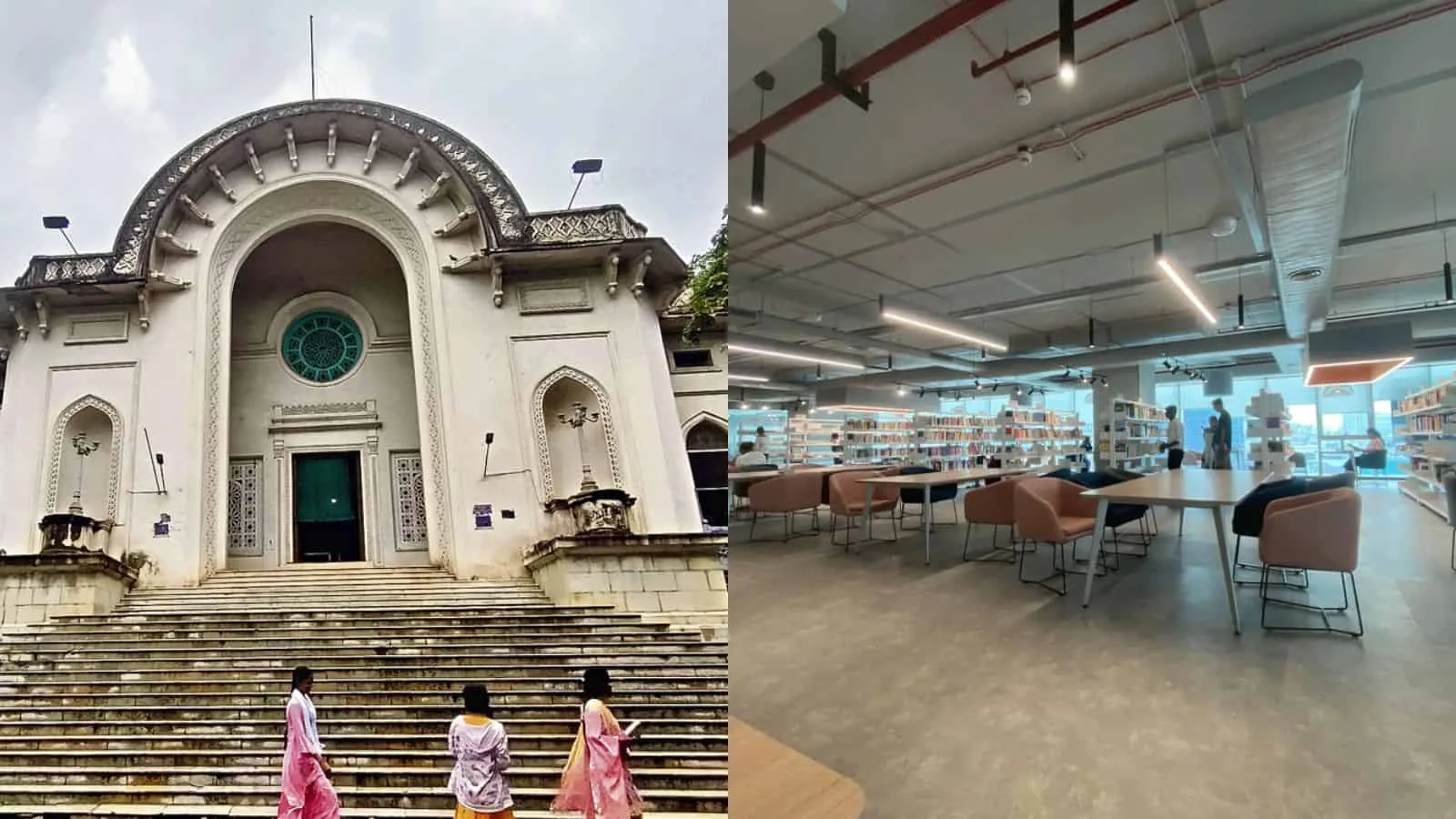
At Afzal Gunj, the domes of the State Central Library rise with quiet authority. The building, constructed during the Asaf Jahi era in 1891, feels like a relic from another time with arched windows, high ceilings, and long wooden tables worn smooth by decades of elbows and notebooks.
Inside, the silence is textured. Ceiling fans whirr above students preparing for competitive exams. In another aisle, an elderly reader turns the pages of an Urdu daily with deliberate care. The library has endured neglect, restoration drives, policy debates and yet, every morning, the seats fill up.
Its evolution is subtle. Catalogues are slowly being digitised. Preservation efforts continue for rare books. The building stands not as a museum, but as a functioning organism. It effortlessly balances fragile manuscripts with modern-day aspirations.
If Afzal Gunj represents institutional memory, Sultan Bazar represents linguistic pride.
The Sri Krishna Devaraya Telugu Bhasha Nilayam was born out of cultural assertion in 1901. At a time when language shaped identity and politics, this space became a sanctuary for Telugu literature. Writers gathered here. Debates unfolded. Poetry was recited not for applause, but for preservation.
Even today, the wooden shelves carry that quiet defiance. The building may not gleam with new infrastructure, but it holds something far more enduring — continuity.
Similarly, the Idara-e-Adabiyat-e-Urdu stands as a testament to Hyderabad’s deep relationship with Urdu. Housing rare manuscripts and literary archives, it feels less like a public building and more like a guardian of a refined tradition. Walking through its corridors is to be reminded that this city was once one of the subcontinent’s great centres of Urdu scholarship.
But the story does not end in sepia tones.
The digital turn
Across the city, libraries are negotiating the demands of a digital generation. The Hyderabad centre of the British Library, established in 1979, underwent a significant transformation in recent years. Once known for its physical collections, the British Council Library has transitioned much of its services online, offering a thriving digital library with e-books, audiobooks, magazines and research resources that readers can access anytime, reflecting how knowledge spaces are adapting to the digital age
The change was not merely cosmetic. It acknowledged a reality: readers now move fluidly between physical and digital worlds, and institutions must follow.
A different kind of evolution can be seen at Sundarayya Vignana Kendram. More than just a 40-year-old library, it functions as an archive, a research centre, and a cultural venue. With film screenings, public discussions, and academic seminars, the space reimagines what a public knowledge hub can look like in the 21st century. Here, reading coexists with dialogue.
Meanwhile, corporate participation has also entered the landscape. In 2025, global IT services firm Coforge inaugurated a large public library in Kothaguda, near Kondapur. Spread across more than 15,000 square feet, the facility houses thousands of books across genres, features fully digitised cataloguing systems, and includes accessible infrastructure such as wheelchair-friendly aisles and dedicated children’s spaces. Open to the public free of cost, it signals how private initiatives are beginning to shape Hyderabad’s knowledge ecosystem.
As Hyderabad grows taller and faster, its libraries continue to evolve quietly. Some preserve fading manuscripts. Others experiment with digital databases and modern design. Yet all of them remain occupied.
In a city where past and future coexist, its libraries prove that knowledge, too, can move forward without letting go.