
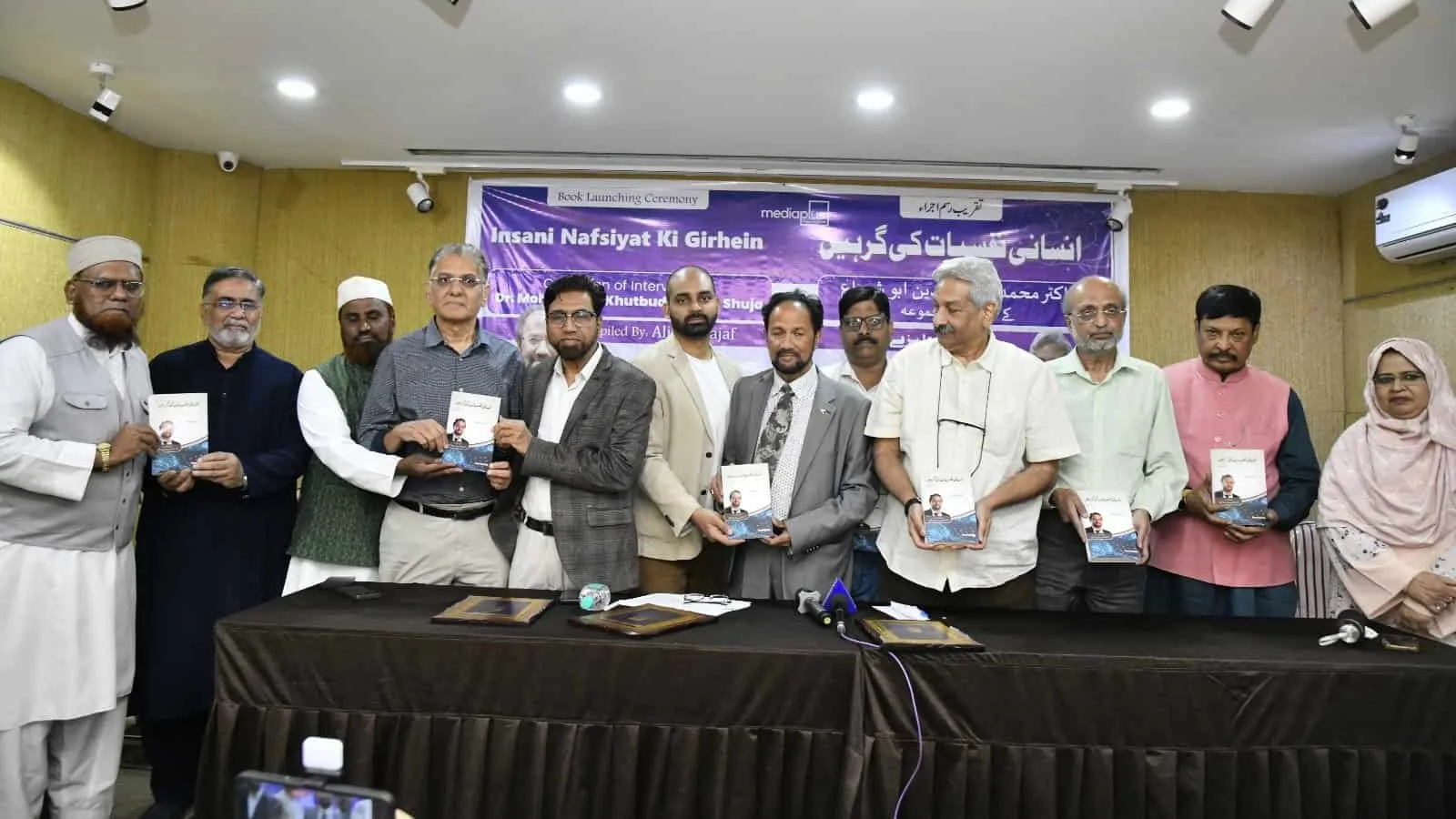
Hyderabad: Nothing in life can torment a person more persistently than their own negative thoughts. A bleak outlook, pessimistic thinking and lack of meaningful communication often lie at the root of psychological distress. According to eminent psychologist Dr Khutbuddin Abu Shuja, developing mental defence, practising mental hygiene and nurturing positive behaviour are not merely philosophical ideas but essential disciplines for living a balanced and contented life.
He shared these insights while speaking at the release of his book “Insani Nafsiyat Ki Girhein” at MediaPlus here on Monday evening, February 16. The book has been authored by Alizay Najaf, drawing from a series of in-depth interviews with the Chicago-based Indian psychologist. The work explores complex psychological patterns, while offering practical pathways toward emotional wellbeing.
Drawing from decades of clinical experience, Dr Khutbuddin emphasised the inseparable relationship between mental and physical health. A healthy body, he said, cannot function in isolation from emotional stability, and a truly meaningful life is impossible without inner peace. The pressures of modern life – competition, comparison and the relentless race for success – have created what he described as a “psychological climate of exhaustion,” giving rise to anxiety, depression and panic disorders.
Yet, the crisis, he suggested, is not merely social but deeply personal. Modern individuals possess vast knowledge about the world but remain strangers to their own inner selves. To illustrate this, he quoted celebrated poet-philosopher Allama Iqbal, whose verse urges individuals to dive within themselves to discover the essence of life and identity.
Apne man mein doob kar paaja suragh-e-zindagi
Tu agar mera nahi banta na ban, apna to ban
(If you cannot be mine, so be it
But at least become your own)
The knowledge of inner recognition
Self-awareness, Dr Khutbuddin explained, is the foundation of psychological healing. He expanded this idea through the spiritual psychology of the self, referring to classical Islamic concepts such as Ilm-e-Marifat – the knowledge of inner recognition and awareness of the Divine. Without this deeper consciousness, he said, human beings remain trapped in Nafs-e-Ammara, the lower self that inclines toward impulses, desires and negativity.
True emotional stability emerges only when a person strives toward Nafs-e-Mutmainna – the tranquil, contented soul that rests in acceptance, balance and spiritual awareness. Psychological wellbeing, he emphasised, is not merely clinical but also moral and spiritual, requiring inner discipline and self-reflection.
Comparing social environments, Dr Khutbuddin observed that in the United States, material comfort is abundant, yet many struggle with loneliness and emotional disconnection. Young people often begin living independently at an early age, which can lead to psychological isolation in the absence of familial support. In contrast, he noted, India still retains strong family structures where emotional burdens are shared and conflicts can often be resolved collectively.
He reinforced this idea of inner peace by citing a verse from the Quran – Ala bizikrillahi tatmainnal quloob – reminding the audience that hearts find tranquillity in remembrance of the Divine. Spiritual grounding, he said, acts as a powerful stabilising force in an increasingly restless world.
Reflecting on his association with legendary boxer Muhammad Ali, whom he once advised, Dr Khutbuddin described him as a deeply compassionate and generous individual. True peace, he said, often comes through empathy and sharing the burdens of others. Yet, modern society, he lamented, has grown emotionally distant – people hesitate even to greet one another warmly.
He also warned about the psychological consequences of digital overdependence. Mobile phones and social media, he argued, have subtly imprisoned human attention and emotional energy. Powerful corporations employ sophisticated psychological strategies to influence behaviour and consumption, often encouraging people to pursue desires rather than genuine needs.
Seeking beneficial knowledge
The solution, he proposed, lies in seeking Ilm-e-Nafe – beneficial knowledge that refines character and promotes meaningful living. Equally important is the revival of reflection and analysis, which he described as essential tools for self-mastery and contentment.
Former Director General of Police (DGP) SA Huda said stress was catching up with every walk of life. He spoke about a research conducted to identify stress among police personnel. He praised the book for addressing a wide spectrum of psychological conditions, including clinical and situational depression, panic disorders, obsessive-compulsive tendencies, schizophrenia, eating disorders, Alzheimer’s disease and the modern phenomenon of FOMO – fear of missing out. Importantly, the book also outlines therapeutic approaches and coping strategies.
Social activist and writer Rafia Nausheen described the work as a practical guide for navigating contemporary life, recommending it for anyone seeking emotional resilience in an increasingly stressful world.
The programme concluded on a lively note, with Fazil Hussain Parvez, Editor of Gawah, engaging the audience with his warm and entertaining compeering.
The evening ultimately delivered a clear message: psychological wellbeing is not achieved through external success alone, but through inner awareness, meaningful relationships and the journey from restless impulses toward a tranquil soul.