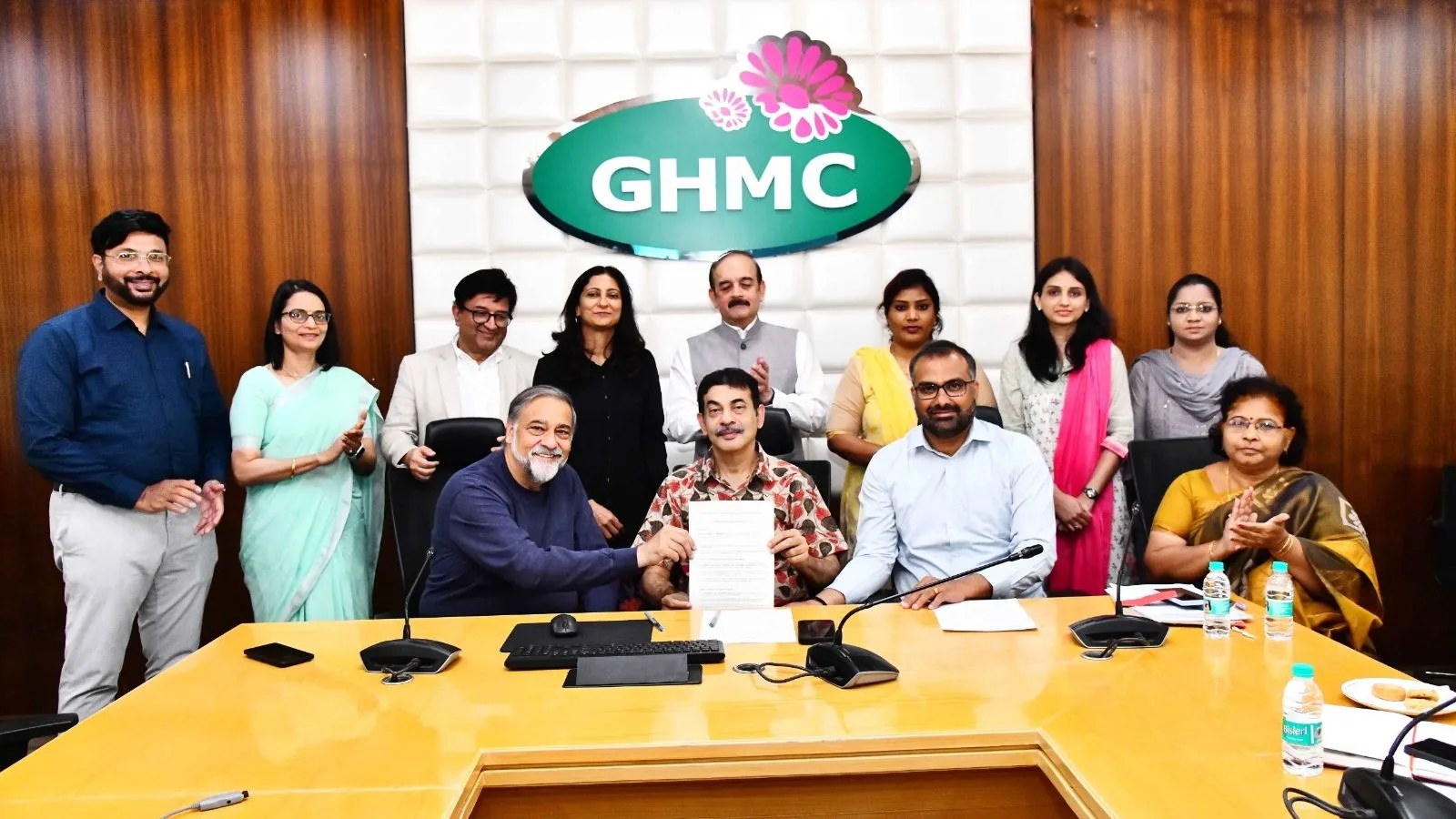
Hyderabad: The Greater Hyderabad Municipal Corporation (GHMC) on Thursday, May 14, announced that it has signed an MoU with the Indian Institute of Technology (IIT) Kharagpur and the All India Institute of Medical Sciences (AIIMS) New Delhi to launch one of India’s most technologically advanced water quality monitoring initiatives.
The project, which is expected to commence in the third quarter of this year, will establish a next-generation water surveillance and early-warning system for Hyderabad, stated a release.
By combining advanced scientific research, artificial intelligence, and real-time environmental monitoring, the system will help protect public health and strengthen long-term water governance across Telangana, it added.
What will the system do?
Unlike conventional water testing systems, which rely on slow laboratory workflows and test for only a limited set of known contaminants, the proposed platform will use advanced nonthermal plasma spectroscopy and artificial intelligence to analyse the complete optical signature of a sample.
This will allow rapid identification of a broad range of contaminants, including heavy metals, industrial chemicals, microbial indicators, and emerging pollutants, while also identifying anomalous patterns that may signal previously unrecognised risks.
The technology already has the ability to detect contaminants even in very low concentrations with accuracy comparable to or exceeding gold-standard laboratory methods.
It is also capable of processing large numbers of samples rapidly while requiring significantly less sample preparation and infrastructure than traditional mass spectrometry systems, GHMC said.
Program to go through 12-month pilot phase
The program will first go through a 12-month pilot phase during which more than 25,000 water samples will be tested from across the Hyderabad metropolitan region, generating approximately 1.9 million individual analytical data points covering chemical, elemental, and microbiological parameters.
The results will then be integrated into a centralised platform for real-time analysis, pattern recognition, and rapid alert generation to support faster intervention and decision-making by relevant authorities.
As part of the MoU framework, all environmental and analytical data generated through the initiative will be protected under the highest standards of cybersecurity, privacy, and data governance.
Access to operational data, monitoring outputs, and system intelligence will be shared exclusively with authorised agencies of the Telangana government and designated institutional partners for public-health and water-management purposes.