Hyderabad: History is often viewed from a very linear perspective when it comes to events that will, in all likelihood, be talked about for generations to come. Be it the partition of India and Pakistan or the 1857 war of independence, very few narratives have moved away from the obvious themes like violence. Hence, this is where an infusion of storytelling provides a fresh perspective.
Oral historian and celebrated partition author Aanchal Malhotra, whose book “The Book of Everlasting Things” is a retelling of Partition, touches upon the subject through the tale of two lovers (Sameer and Fridaus) who find their innocent love torn asunder due to India and Pakistan splitting in 1947. Aanchal, in fact, uses the sense of smell to build a connection and weave a story that gives readers an entirely different dimension to look into.
“For me, stories of war kept coming up during my work. And the question for me was how to connect World War I, which has almost disappeared from memory. Love in the 1920s, 1930s and the 1940s was innocent love. There is a scene where Sammer and Firdaus just look at each other (only). I feel this innocent love added a texture of the time, and only a novel can do this,” said Aanchal on why she chose to narrate the historical event through a love story.
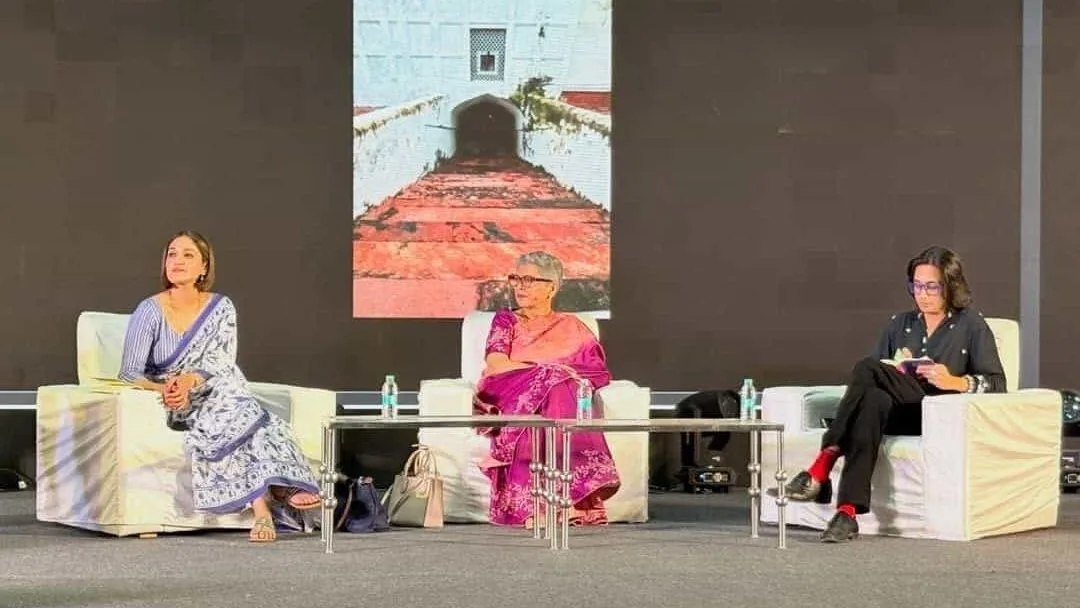
The author’s reflections on her works came up during a panel discussion with fellow authors and historians Rafa Safvi and Eric Chopra (moderator) at the History Literature Festival held at the Hyderabad Public School. Speaking further about her work, Aanchal also pointed out that the reason for India to enter the war was very “exciting,” as a country ruled by colonial powers like the British.
“It is the first time Indian soldiers cross waters; many of them are from Punjab who have never crossed the sea,” she noted. Safvi, also speaking on the same topic, noted that people often remember “doomed stories” and it was one of the reasons for her to write a book on the 1857 revolt.
“How much of it can we twist? I asked editors if I could create a daughter for Bahadur Shah Zafar. I wanted to show that the harem was a place where women had agency. There was a very well-structured place with account keepers, etc. I was trying to show that these were highly qualified women,” said Safvi, whose book “A Firestorm in Paradise” weaves stories of Shahjahanabad from around the time of the 1857 revolt.
‘Tools of a historian with imagination’
Throughout the discussion, the subject of discussion was how history could be written or depicted through stories, parallel with facts. “You have the tools of a historian, but you also need imagination. My main problem with a largely traumatic moment in history is that we viewed partition only through violence, but it must also incorporate some love,” opined Aanchal.
She recalled stories from her field work while writing her books about how people still vividly held on to their memories of love from childhood, often for decades. Talking about her book, the author explained that Sameer becomes besotted with Firdous because he is gifted with an incredible nose, and hence becomes attracted to her smell.
“So as I am writing this story, where Sameer is cleaning glass, as he is only working and he sees this girl. He wants to see her again and again, and wants to smell her again and again. So he takes classes from her father, who teaches calligraphy at the Wazir Khan mosque, and is trying to find ways to speak to her,” said Aanchal.
The panel discussion on the final day of the literature festival saw a packed hall with scores of Hyderabadis waiting to meet all of the authors for autographs.