
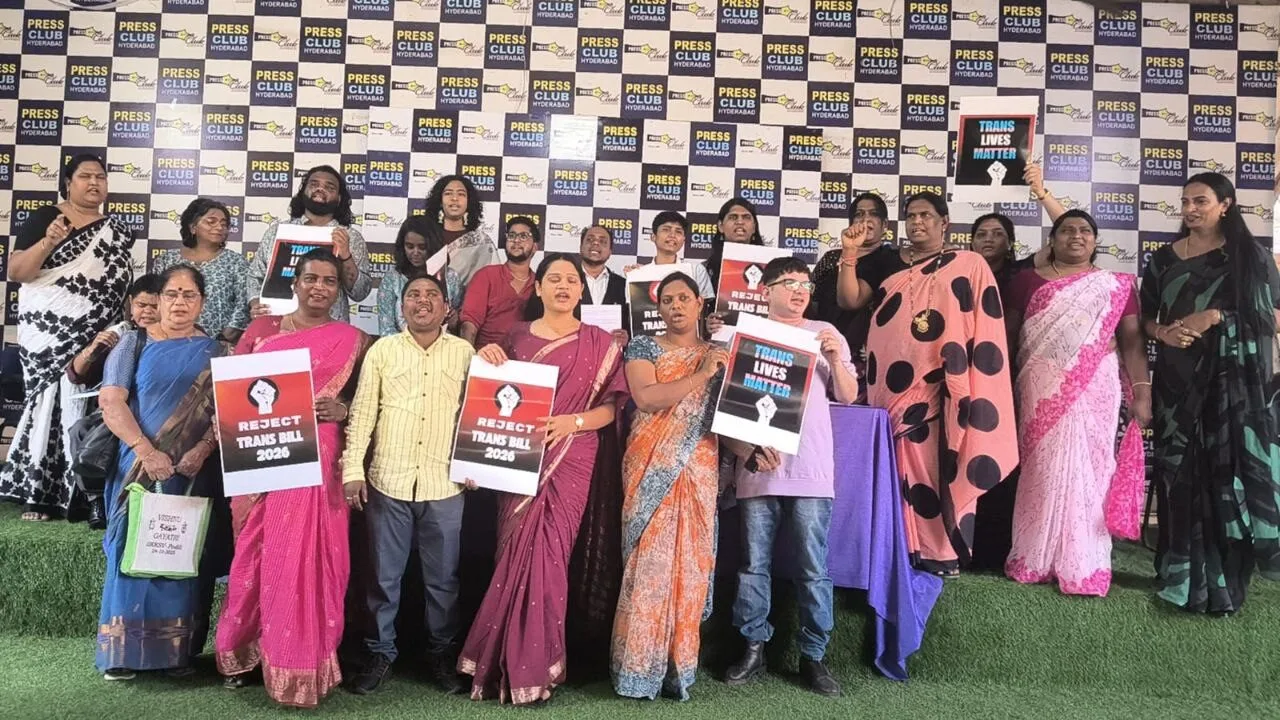
Hyderabad: Transgender, intersex, gender nonconforming, queer individuals, collectives, and allies in Hyderabad formally opposed and condemned the Transgender Persons (Protection of Rights) Amendment Bill, 2026, that was introduced in the Lok Sabha on March 13 by Union Minister for Social Justice and Empowerment Dr. Virendra Kumar.
The Hyderabad community of activists called on lawmakers to withdraw the Transgender Persons (Protection of Rights) Amendment Bill, 2026 immediately and “without condition”. “Any future amendment must retain the definition of “transgender person” as established in the 2019 Act, uphold the right to self-identification as affirmed by NALSA (2014) vs Union of India, and K. S. Puttaswamy (Retd) and Anr. vs Union of India (2017) judgements, and be developed only through meaningful, democratic consultation with transgender communities across India,” they said.
At a press confere in Hyderabad on Tuesday, MArch 17, the community said that the bill threatens to undo over a decade of hard-won legal protections. Stating that it is a step backwards for constitutional rights, transgender, intersex, gender nonconforming, and queer communities in Hyderabad unequivocally stated that it erases entire identities, mandates invasive medical procedures, criminalises community support networks, and creates a two-tier citizenship where legal existence depends on access to surgery.
“It is not a reform. It is a reversal of the Supreme Court’s NALSA judgment, of the 2019 Act, and of decades of hard-won constitutional protections. The amendment proposes to replace self-identification with mandatory medical certification by a government-appointed District Medical Officer, with no defined criteria, no transparency, and no accountability. Medically, there is no biological marker that confirms or denies transgender identity,” said a statement from the activists.
Community members and activists said that the current bill also introduces a provision under which a person undergoing gender-affirming surgery has to report it to the District Magistrate, which violates the constitutionally provided fundamental right of privacy. “Forcing individuals through physical examinations to “prove” their gender is not only scientifically baseless but also deeply traumatic and unconstitutional,” added the statement.
They pointed out that the bill is “particularly” alarming because it erases entirely the identities of people, and restricts the definition of “transgender person” to a narrow set of socio-cultural identities and intersex variations. Activists added that the bill excludes trans men, trans women who are not part of socio-cultural communities, non-binary individuals, genderqueer people, and gender-diverse persons across India.
At the press briefing, activists also said that trans men will be “rendered entirely invisible as they will have no socio-cultural framework recognised by the bill. “They face deep marginalisation already because they are assigned female at birth and carry the burden of presenting as a woman compulsorily and cannot safely come out in many contexts. This bill worsens each of those realities,” added their statement.
The bill gives offers legal recognition only via medical intervention, which forces individuals toward surgeries they may not want, cannot access, or are medically unable to undergo, said the activists.
‘Criminalisation Is Not Protection’
The activists from Hyderabad also pointed out an alarming criminal provision in the Transgender Persons Amendment Bill 2026, under Section 18 that allows imprisonment of up to five years for “alluring” or “forcing” someone to become transgender.
“There is no credible evidence that such conduct exists as a social pattern. What does exist and what this provision threatens is the vast community support network that transgender persons rely on: fundraisers, temporary housing, help escaping abusive households, access to therapy, and gender-affirming healthcare,” they stated.
The statement said that providers of gender-affirming care, supportive parents, and community members who have historically protected and nurtured transgender individuals now face the risk of criminalisation. “This echoes the legacy of colonial-era laws such as the Criminal Tribes Act of 1871 and the Telangana Eunuchs Act of 1919 which are laws that treated gender-diverse communities as inherently devious and criminal,” it added.