Hyderabad: As the festive spirit of Sankranti rises and the winter sky fills with colourful kites, an invisible danger lurks overhead. What is meant to be a celebration of joy, togetherness and tradition has increasingly become a season of fear. The culprit is the notorious “killer manja” – the Chinese and glass-coated thread that has turned a harmless pastime into a lethal threat, not only for birds and animals but for humans as well.
Reports of bike riders suffering grievous injuries due to razor-sharp manja are pouring in from across the city. In a recent incident at Uppal, a software engineer narrowly escaped death when the Chinese manja slit his throat while he was riding his motorcycle. Alert passers-by rushed him to a nearby hospital, saving his life just in time. In another case, a man sustained serious neck injuries on the Amberpet flyover after coming in contact with the deadly thread. Such incidents have become disturbingly common during the kite-flying season, with bikers being the most vulnerable as the nearly invisible string snaps tight around the neck, often causing profuse bleeding.
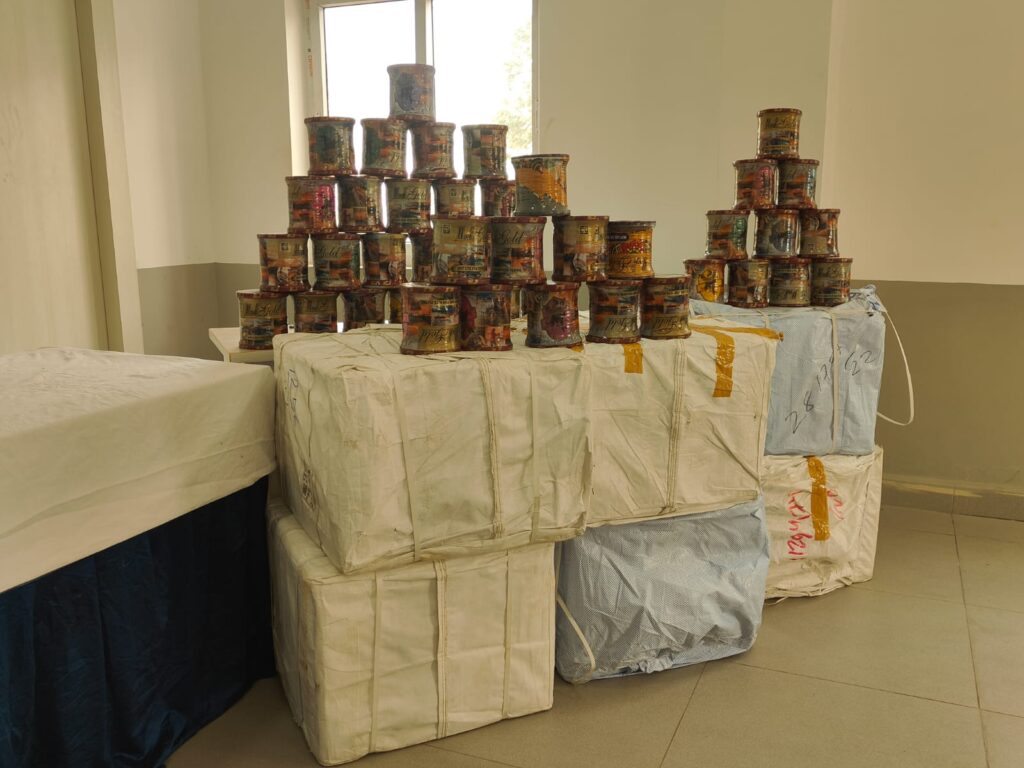
Despite the Telangana government’s proactive measures – including a ban on the procurement, stocking, sale and use of Chinese manja and glass-coated threads – the menace continues unabated. The killer strings remain easily available in markets, openly flouting the law. Even repeated appeals by the government and animal welfare organisations such as Humane World for Animals India appear to have had little impact. In effect, a festival rooted in warmth, compassion and collective happiness has been transformed into a cause for anxiety and alarm.
The demand for Chinese manja remains high, primarily because many kite enthusiasts prefer it over traditional cotton thread. Stronger and more durable, it offers a competitive edge in kite battles. For manufacturers and traders, it translates into higher profits. This commercial incentive ensures that ethical concerns are brushed aside. Appeals by well-meaning citizens to celebrate a cruelty-free and compassionate Sankranti frequently fall on deaf ears.
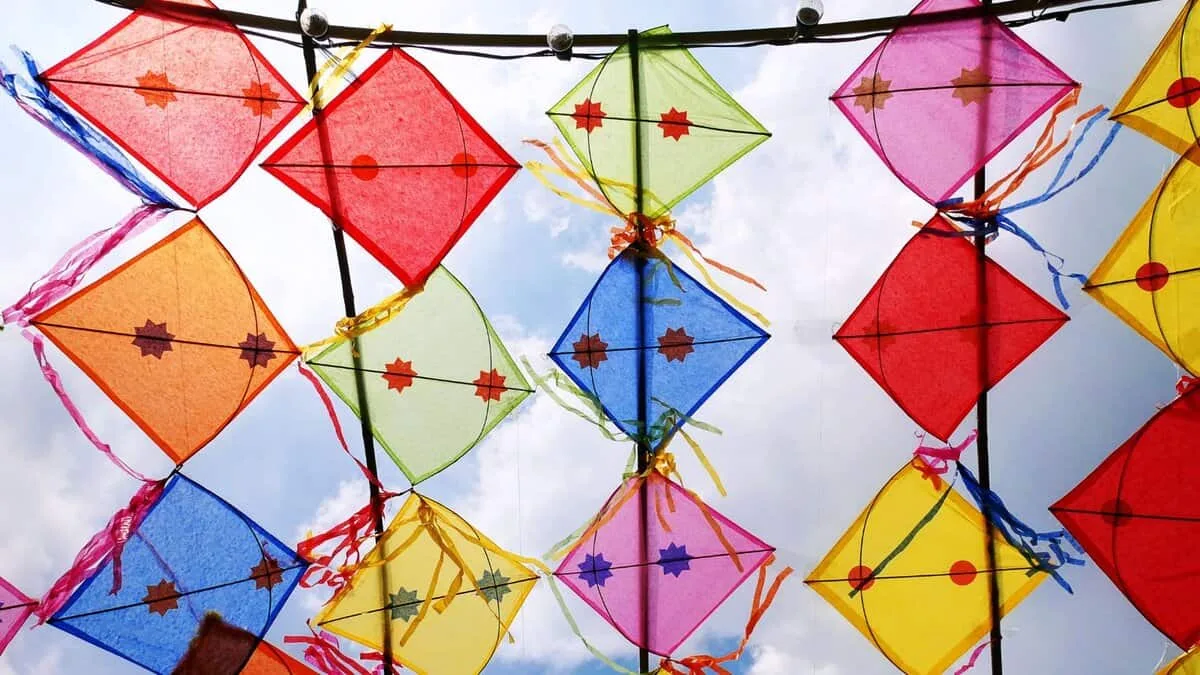
Ironically, even as the danger looms large, Hyderabad’s skyline is drenched in colour. Kites of every imaginable hue, size and theme have flooded the markets. The famous Patang Bazaar at Gulzar Houz near Charminar is once again bustling with activity, drawing crowds from all corners of the city. Shopkeepers do brisk business as families stock up for the festival.
Children, as always, are spoiled for choice. There are kites featuring popular cartoon characters like Chota Bheem, Spiderman and Mickey Mouse. Film buffs can pick kites adorned with images of their favourite movie stars. Then come the novelty designs – kites shaped like eagles, butterflies, Barbie dolls and a variety of abstract forms. The sheer diversity reflects how deeply kite flying is woven into the cultural fabric of the city.
Over the years, the romance of kite flying has not waned. If anything, it has acquired layers of meaning. What began as a simple recreational activity has evolved into a social and even religious tradition, cutting across faiths and communities. People from different backgrounds take to rooftops with equal enthusiasm, sharing laughter, rivalry and camaraderie.
In recent times, however, the sport has also taken on political overtones. For politicians, kite flying has become a symbolic and strategic pastime. For the All India Majlis-e-Ittehadul Muslimeen (AIMIM) in particular, the Sankranti kite festival is a blessing in disguise. With the kite as its election symbol, the party leaves no stone unturned to capitalise on the season, using the imagery to reinforce its political presence and connect with the masses.
Historically, kite flying has an illustrious past. Named after the graceful hawk, the sport is believed to date back to 5th century BC, when it was invented by Greek mathematician Archytas of Tarentum. Over centuries, it spread across continents and became a national pastime in countries such as China, Korea and Japan. Beyond recreation, kites have also served scientific purposes. Before the advent of balloons and aircraft, kites were used for weather observation, carrying instruments aloft to record atmospheric data.
For the uninitiated, the world of kite flying comes with its own vocabulary – a patang jargon that reflects the sport’s rich subculture, especially in Hyderabadi style:
Saadi: Plain cotton thread
Manja: Special thread reinforced with glass pieces and adhesive.
Charakh: Wooden or plastic spindle.
Doredar: Kite with a thin thread on all sides.
Kanne dalna: Technique of tying the thread to the kite.
Dheel: Releasing the thread to let the kite soar.
Kheench: Pulling the thread sharply.
Kan khana: When the kite drifts to one side.
Dasti marna: Rolling the charakh using both hands.
Lapetna: Engaging the opponent’s kite.
Landor: A thread with a stone attached to retrieve stuck kites.While the language and lore of kite flying continue to charm generations, the urgent need of the hour is responsibility. Without strict enforcement of the ban and a collective commitment to abandon killer manja, the skies will remain dangerous. Sankranti should lift spirits – not end lives.