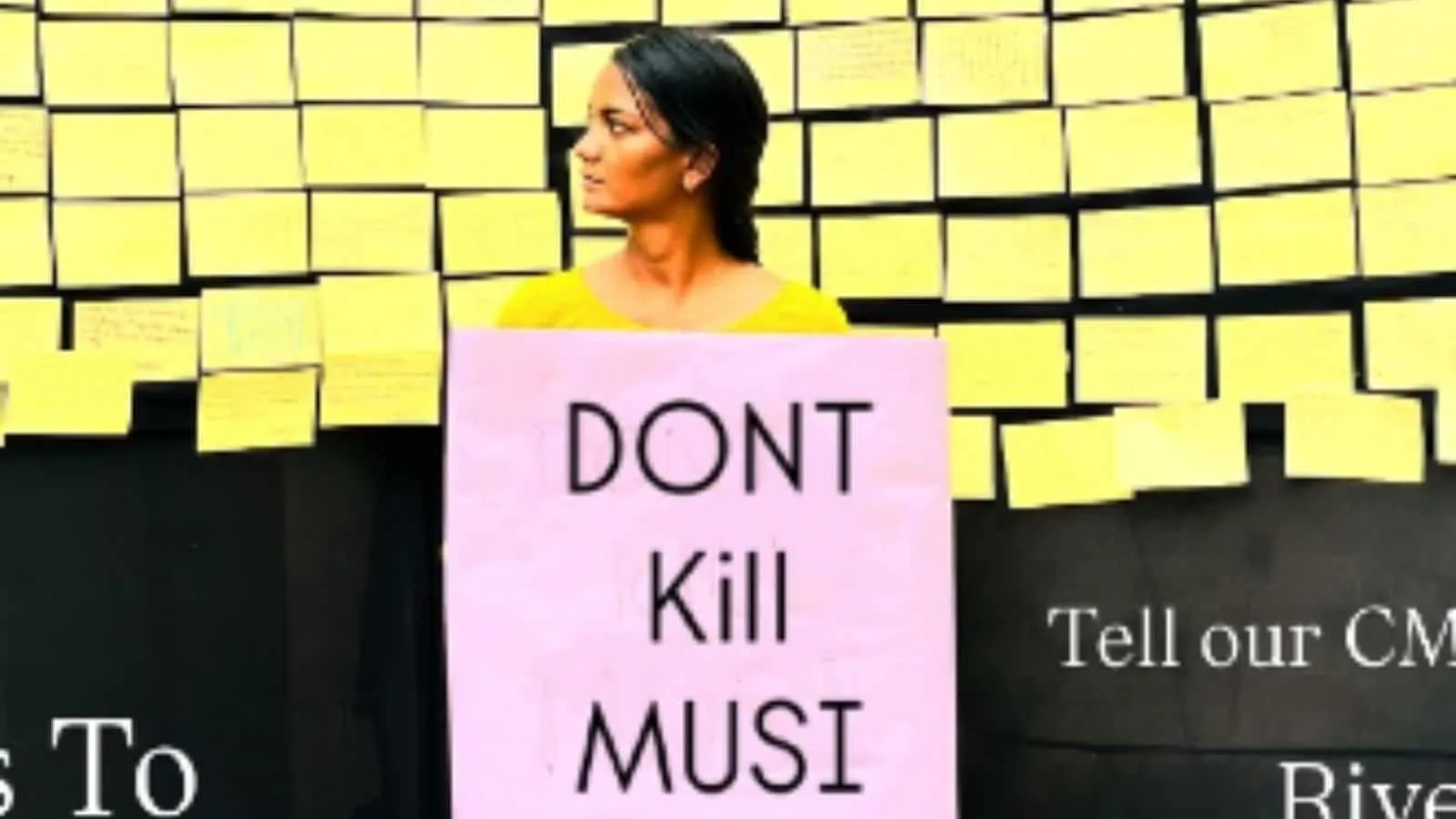
Hyderabad: The Save Musi Movement (SMM) has described the Telangana government’s official river embankment blueprint as a hydraulic bomb, “not intended to save the river, but to build a multi-billion real-estate corridor disguised as a park.”
Addressing the media in Hyderabad on Monday, May 18, the Save Musi Movement activists demanded an immediate freezing all active funds, including the recently released Rs 375 crore, one part of the total Rs 1,500 crore budget allocation for the first phase of the Musi Riverfront Development Project.
They argued that spending hundreds of crores of taxpayer money while keeping the actual blueprints “hidden behind the administrative veil of GO 921” was an attempt to bypass the mandatory Social Impact Assessment (SIA).
The state government must release the Environmental Impact Assessment (EIA), detailed hydrological and flood reports, comprehensive sewage and source-pollution studies, biodiversity and ecosystem reports in Telugu and Urdu languages for independent scientific audit before any further steps were initiated in the project’s implementation, they demanded.
‘This project is a 21-km concrete tomb’
Terming the resultant of the first phase of the project as a “21 km Concrete Tomb,” the activists said that the state government intends to replace the natural riverbed with a rigid, 70m-wide central floor of CCM30 grade concrete and PCC 1:3:6. They argued that this completely seals the riverbed, destroying the city’s underground water table and cutting off the vital borewell recharge system of millions of Hyderabad’s residents.
SMM warned that this will create a “drain effect,” pulling existing groundwater out of the neighbourhoods of Puranapul and Chaderghat, drying up the surrounding borewells.
The activists argued that by squeezing the wide natural floodplain into a narrow 108-meter concrete lane, the project would turn the Musi River into a “Hydraulic Bomb”.
SMM warned that water will travel at 2 to 3 times its natural speed, creating sudden water surges inside the city and violently exporting artificial flash floods to unsuspecting farmers downstream.
They cautioned against laying roughly 560 to 1,000 acre concrete and asphalt roads, which will trap solar radiation, creating a severe Urban Heat Island (UHI) effect that will permanently bake high-density surrounding neighbourhoods, driving up ambient night temperatures by 3°C to 5°C and, as a result, severely impacting public health.
The activists rejected the state government’s attempts to benchmark the Sabarmati Riverfront Project as a success, terming it the “Sabarmati Illusion” and “Aesthetic Lies.”
“Official data proves that the Sabarmati remains one of India’s most polluted rivers; its ‘clean, blue’ urban stretch is a dead, stagnant pool filled by diverting Narmada canal water to mask heavy downstream pollution,” alleged Ruchith Asha Kamal, a representative of SMM.
“The plan to pump 2.5 TMC of Godavari water into the Musi is a direct copy of this aesthetic fraud. Diluting raw sewage with fresh water inside a concrete-lined bathtub is a climate crime and a flagrant waste of public electricity. We do not want a fake blue river; we want a living, breathing Musi,” he demanded.
Make all documents public: Activists
SMM demanded that the state government halt all physical riverfront building, road planning, and embankment construction on the Musi river immediately, and scrap the “current real-estate-driven blueprints.”
The activists demanded that the state government prioritise the long-pending 2019 Council of Scientific and Industrial Research – National Environmental Engineering Research Institute (CSIR-NEERI) action plan to build 21 new Sewage Treatment Plants (STP) and stop the 1,800 million litre of daily sewage entering the river at its source.
Instead of “wasting public funds on concrete roads and promenades,” SMM demanded the legislation of a dedicated and transparent Musi River Basin Authority to protect the entire 11,212 sq km basin, reinstate strict catchment protections like GO 111, and focus on “nature-based phyto-remediation instead of corporate gentrification.”
SMM demanded that the state government sit across the table with the locals, hydrologists, and grassroots stakeholders in the bastis of Chaderghat, Amberpet, and Puranapul to design a bottom-up and decentralised river management alternative.
“We issue a clear message to CM Revanth Reddy: withdraw your warnings, scrap this unscientific blueprint, and bring the papers to the table. If this massive over Rs 375 crore active release is genuinely for the benefit of Hyderabad, why is the state terrified of letting its own citizens see the reports?” SMM questioned.