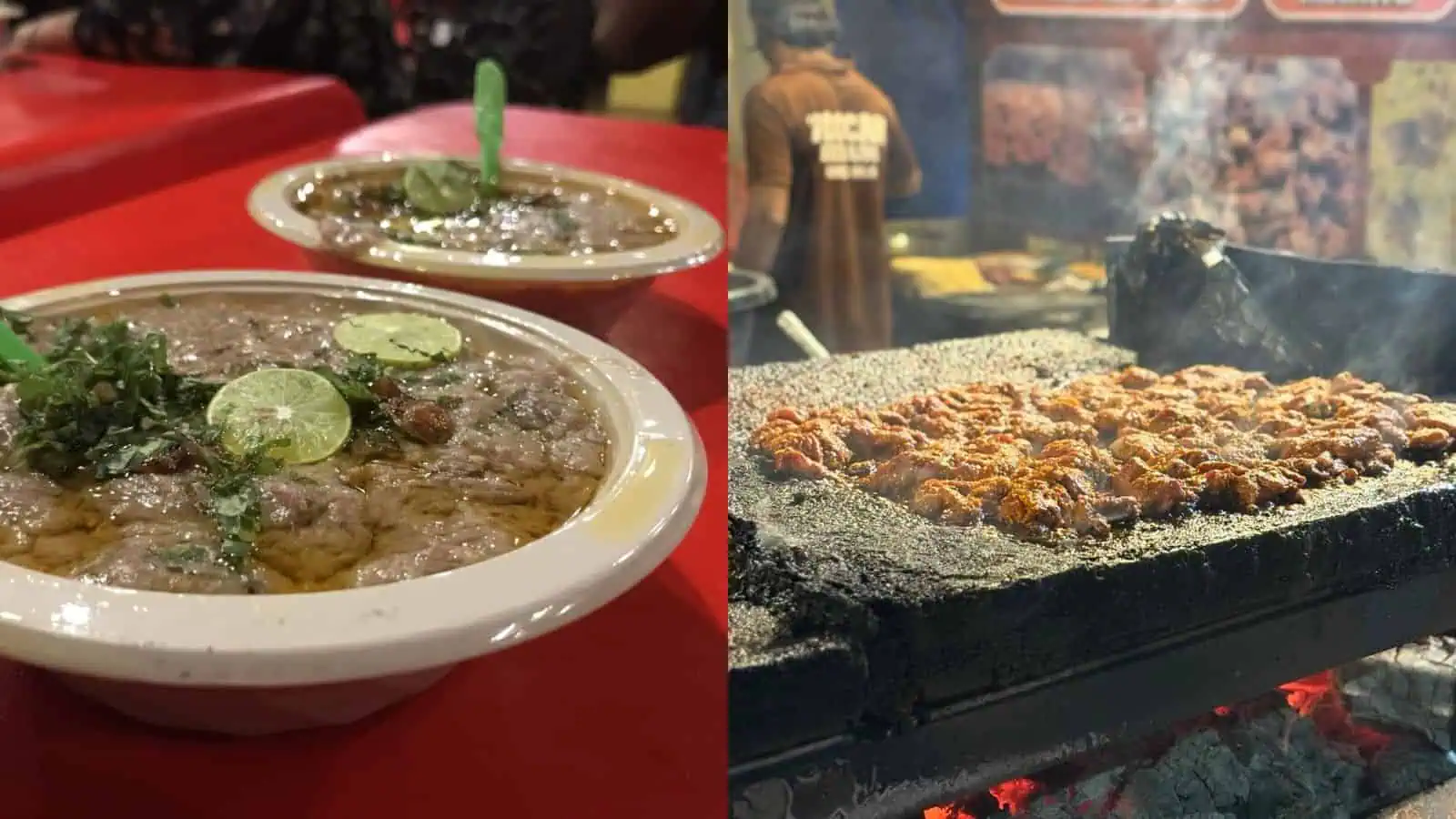
English has its “delicious”. Urdu possesses a thousand ways to say “lazeez”. Telugu food vocabulary has nuanced layers of “kammaga undi” or “adhiripoyindi”. But when you are standing in the middle of a Hyderabad food street with a bowl of haleem in hand, and all languages fail you, Dakhni comes to the rescue with its loud and emotive lexicon.
In Dakhni, food is never merely “mazeka“, it is an all-encompassing, high-octane event that demands a vocabulary as large. While other languages describe food from a distance, the language of Deccan moves in close and describes each precise moment of what food does to your body.
From the numbing sting of the first bite to the sweet intoxication of the last, Siasat.com has prepared a guide to navigating a Ramzan food walk using the Dakhni vocabulary.
A recipe of words
Your food walk will most probably begin with the unmistakable talan ki khushbu (scent of deep-fried food) that hangs thick in Hyderabad’s air during Ramzan. With this oily, savoury perfume, you eat with your nose first before your mouth. Next, you eat with your eyes, scanning for the teera (oily layer on the surface) in deghs of haleem or bowls of marag. While standard Urdu calls it rogan, the Dakhni critic looks for that shimmering layer of teera released by spices and meat. For the side snacks, the auditory benchmark is kurum, if a lukhmi or samosa does not shatter with a crunch, it is not worth eating.
When the evaluation moves to the tongue, there are more benchmarks for dishes. The Ramzan treat dahi vade are described as sondha, a deep, earthy taste that can only come from besan that has been treated with respect.
Beware! The Dakhni language is a harsh judge of balance. If a dish is bland or lacks that essential hit of spice, it is instantly dismissed as phikka phudhus. Pronounced with a sharp, judgemental stress on the “kka”, the word encompasses a personal betrayal to Hyderabad’s culinary legacy. Similarly, if the tamarind in your dalcha has gone rogue, you are left with khatta dhaan of a dish. With a stress on the “tta”, you warn the other foodies about the taste.
Pronounced with a heavy stress on “ttha”, mittha madd is a word used to describe something so overly sweet and indulgent that it sends you into a heavy, sugary trance. As the spice levels peak, you enter the state of mirchi ka madu. This is not just “spicy”, this word describes an intoxication that makes your brain fog and your forehead glisten.
The anatomy of Dakhni vocabulary
Once the flavours hit that sweet spot of excellence, the language shifts from the palate to the entire body. Vivid and descriptive phrases like kalle lap lap marlere will be thrown around instead of just using the word “drooling” over good food.

The action of running your tongue over part of your mouth to savour the taste? Well, we have a phrase for that too- jeep jabde khangaalna (rinsing the tongue and jaws). It is a linguistic and physical scour of the palate that reminds us why Hyderabadi Urdu is also a language in its own right, rich with local flair and a very specific kind of humor.
In the final moments of your walk, a dessert that transcends reality is a must. And this is when you declare aankhan palat gaye khaake—your eyes literally roll back in ecstasy at the sweetness.
The culmination of any Ramzan food walk is the declaration: hallaq tak khaaliya! A victory cry, of sorts, of eating to your heart’s absolute limit, until the food literally reaches your throat (hallaq).
As you slip into this food-induced coma, you realize that Dakhni survived the fall of empires because it lives in the gut. It is a language that stretches and stresses just as much as your stomach does on a Ramzan night.