
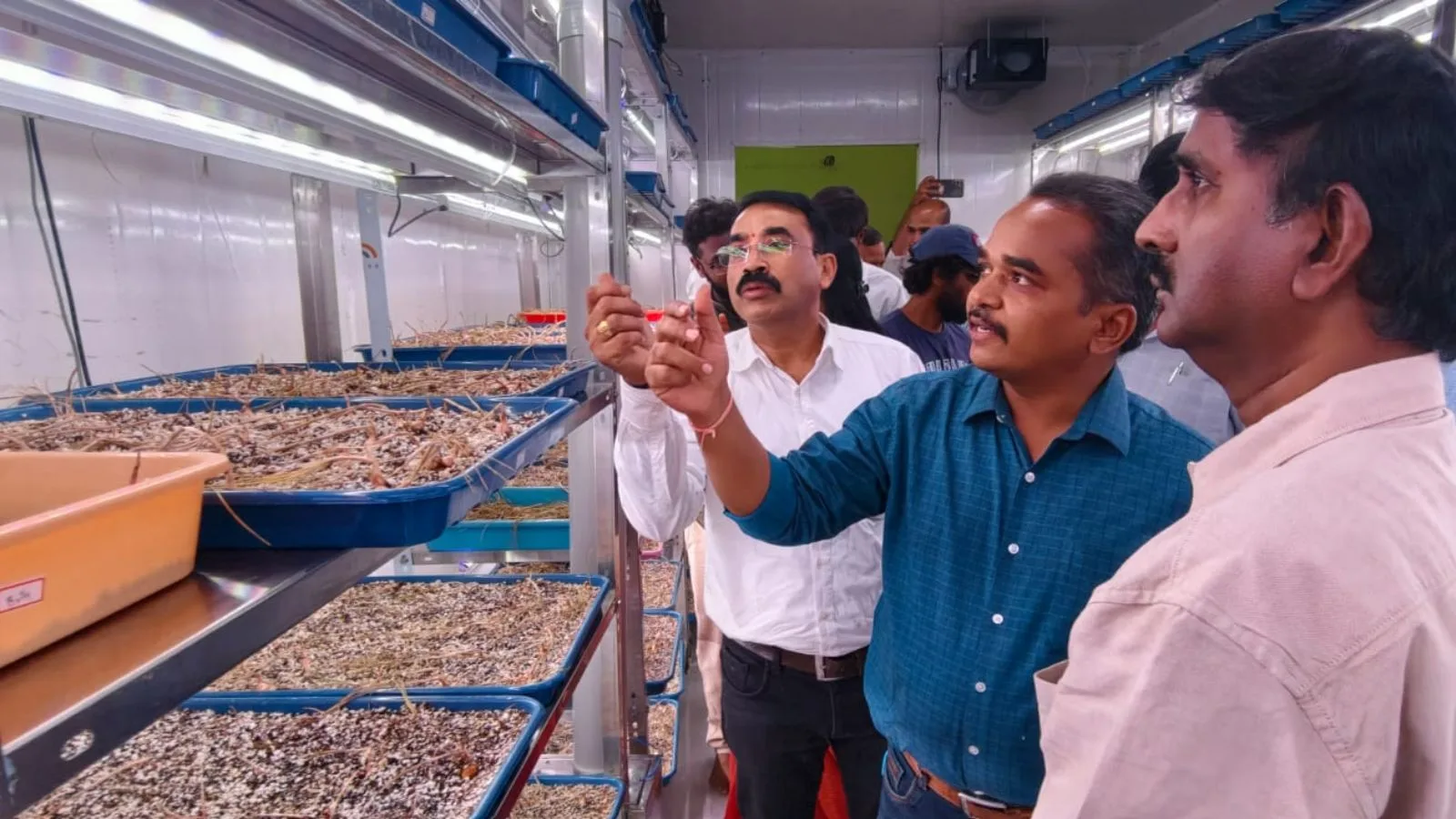
Hyderabad: Saffron cultivation under controlled environment has been gaining traction in Telangana, with some progressive and educated farmers growing these flowers to make a good profit. With an aim to conduct more research on costs, yields and technological intervention needed, Sri Konda Laxman Telangana Horticultural University (SKLTGHU) has established a laboratory for researching the cultivation of saffron using the aeroponic method.
The aeroponic saffron laboratory has been set up at the university’s College of Horticulture in Mojerla village of Peddamandadi mandal in Wanaparthy district, with financial assistance from the National Bank for Agriculture and Rural Development (NABARD), so that farmers from the region can reap the benefits of the research.
B Uday Bhaskar, the Chief General Manager of NABARD, Telangana, along with Dr D Raji Reddy, Vice-Chancellor of SKLTGHU, inaugurated the aeroponic saffron laboratory on Friday, April 10.
The aeroponic saffron laboratory will specifically undertake comprehensive research on modern methods of saffron cultivation within the state.
What is aeroponic saffron farming?
Aeroponic saffron farming is a high-tech, indoor, soil-free method where saffron corms are suspended in air and misted with nutrients. This technique allows for year-round production, reduces water usage by up to 90 per cent and provides high yields, enabling farmers to produce premium saffron in controlled environments, often bypassing traditional climatic restrictions.
Kashmir is known for cultivating the best quality saffron not only in India but across the world. Saffron is one of the world’s most expensive spices. It costs between Rs 1.5 lakh and Rs 2.5 lakh per kilo.
Speaking at the training program on aeroponic saffron cultivation methodology in Telangana at the College of Horticulture on Friday, Uday Bhaskar noted that cultivating saffron using the aeroponic method within an artificially controlled environment has already yielded promising experimental results in the state.
He added that it was now possible to achieve high yields of exceptionally high-quality saffron in the future, entirely free from pesticide and pest-control residues.
He stated that significant improvements in the agriculture, horticulture and allied sectors are achievable in the future through the application of modern technological methods and innovations.
Observing that the Telangana Rising 2047 vision document placed immense emphasis on the application of modern technology, particularly within agriculture and allied sectors, he felt that innovations such as the Internet of Things (IoT), artificial intelligence (AI), machine learning, sensor-based farming and the cultivation of saffron using aeroponic methods would significantly contribute to the establishment of startups.
NABARD would encourage methodologies to enhance farmers’ incomes’
The Chief General Manager assured that NABARD would encourage all avenues and methodologies aimed at enhancing farmers’ incomes through the adoption of new technologies in cultivation.
He commended the experiments conducted by the university which focused on controlling factors such as temperature, artificial light and atmospheric humidity to achieve high yields of high-quality saffron.
He said that once the comprehensive results were available, a detailed unit cost analysis for saffron cultivation using the aeroponic method would be prepared.
Uday Bhaskar also observed that by enhancing the skill sets, student-led startups and entrepreneurial ventures would garner immense popularity and support in the future.
Dr D Raji Reddy stated that the university would conduct research on modern technological aspects and disseminate the findings to farmers on a regular basis.
He urged the farmers to embrace cultivation practices that were grounded in scientific and technological principles.