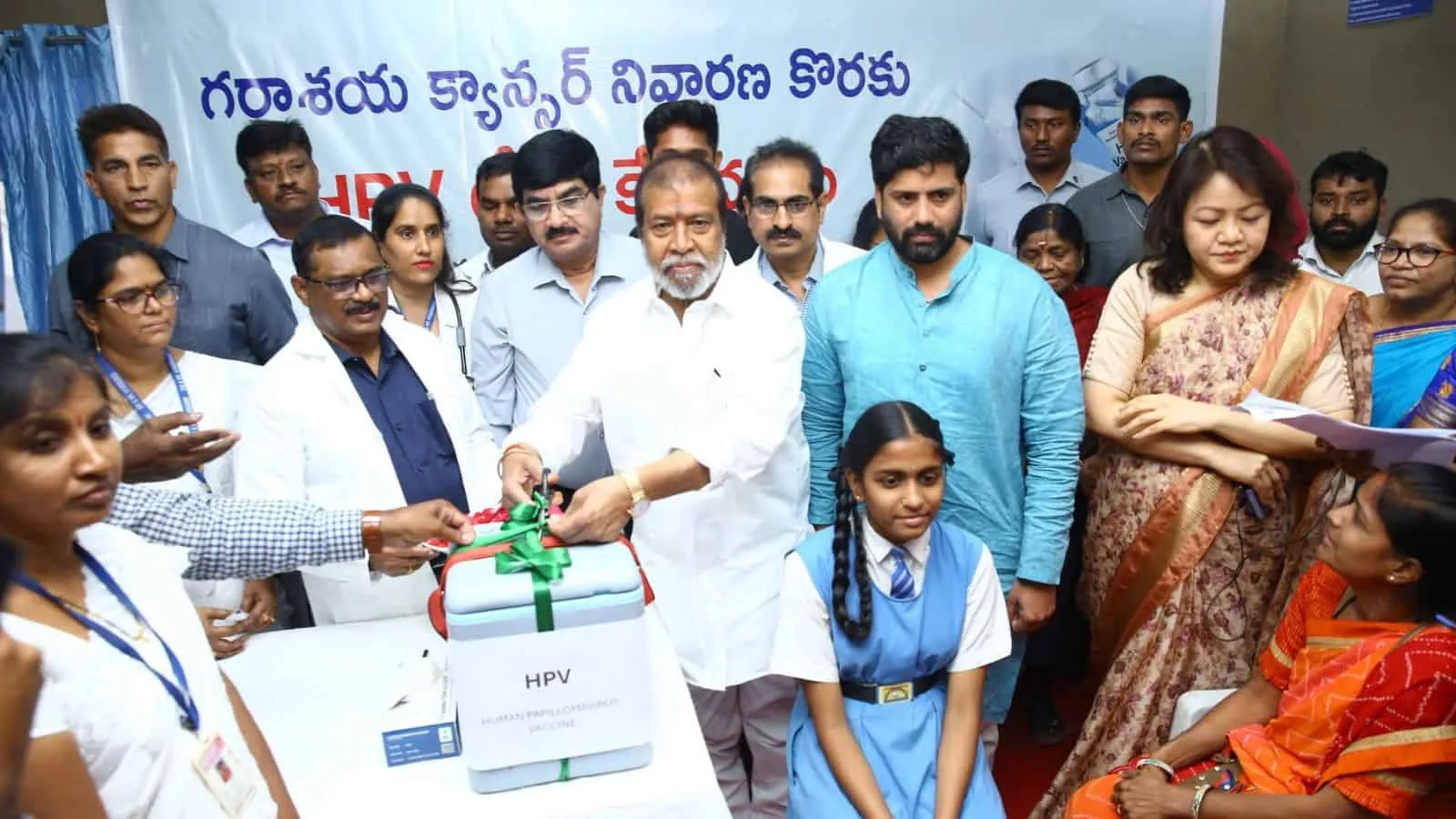
Hyderabad: Telangana Health Minister Damodar Rajanarsimha on Saturday, February 28, launched the state’s Human Papillomavirus (HPV) vaccination drive at King Koti Hospital in Hyderabad, as part of a nationwide programme initiated by Prime Minister Narendra Modi.
The three-month special campaign, running in mission mode, will cover girls aged 14 to 15 years, with the state targeting nearly 3.5 to 4 lakh beneficiaries. During this period, eligible girls can receive the vaccine daily at designated facilities.
In the first month, the vaccine will be available at government general hospitals, area hospitals and community health centres, before being extended to Primary Health Centres (PHCs). After the three-month campaign, the vaccine will continue to be available on routine immunisation days.
The national programme targets approximately 1.15 crore girls aged 14 years every year across all states and Union Territories, according to a Press Information Bureau release.
Cervical cancer kills nearly 80,000 women in India every year, with over 1.2 lakh new cases reported annually, according to GLOBOCAN 2022 data. Scientific evidence shows that almost all cases are caused by high-risk HPV types, particularly types 16 and 18. Despite being largely preventable through vaccination and early screening, cervical cancer continues to place a heavy burden on families and the health system, which the national programme aims to address directly.
In Telangana, approximately 55,000 to 60,000 cancer cases are registered annually, according to the Chief Minister’s office. Cervical cancer is the second most common cancer among women in the state, affecting around 3,200 women every year.
India’s national programme will use Gardasil, a quadrivalent HPV vaccine that protects against HPV types 6, 11, 16 and 18. The vaccine, which costs Rs 3,000 to Rs 4,000 per dose in private hospitals, will be provided free of cost under the programme. The vaccination is voluntary, and informed consent from parents or guardians will be obtained before administration.
Health group raises concern
Earlier this month, Universal Health Organisation (UHO), an Indian independent watchdog body formed in 2022 by a group of doctors and professionals, raised concerns about the vaccination drive, citing instances from undivided Andhra Pradesh and Gujarat between 2009 and 2010, where girl recipients had reported severe effects such as epileptic seizures, severe stomach aches, persistent headaches and mood swings following vaccination.
According to the organisation, a Parliamentary Standing Committee and independent investigators also found grave violations, including improper consent procedures, language barrier in consent forms, absence of parental notification, inadequate adverse event monitoring, and conflicts of interest.
Therefore, the UHO had demanded prior informed consent, voluntariness and freedom from coercion, comprehensive adverse event monitoring and response, independent ethical oversight, transparency in funding and conflicts of interest, community awareness and social mobilisation.
Govt addressed concerns
The government, addressing such concerns, said that each vaccination session will be supervised by trained medical officers, supported by skilled healthcare teams.
Additionally, all sites will have functional Cold Chain Points (CCP) and will be linked to 24×7 government health facilities to ensure immediate medical support and management if any rare Adverse Events Following Immunisation (AEFI) are found, the PIB said.