
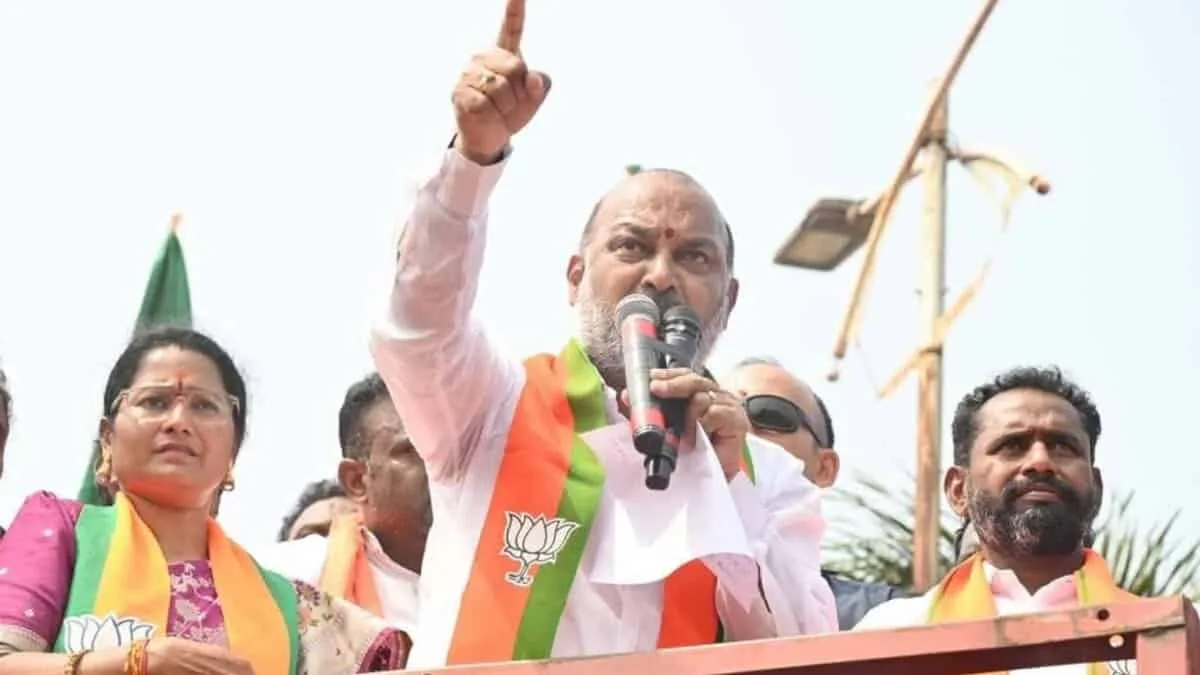
Hyderabad: Union Minister of State for Home Affairs Bandi Sanjay Kumar on Saturday, February 28, alleged that individuals with “urban Naxal” ideology were part of the state-appointed Education Commission, as he criticised the panel’s recommendations as “unilateral and harmful to poor students.”
Addressing a press conference at the BJP state office, Sanjay claimed that the commission had prepared its report without consulting teachers or other stakeholders.
Report prepared without consultation: Sanjay
Sanjay said the Education Commission members did not hold discussions with teachers or concerned groups before finalising the report. He objected to the panel’s observation that teachers’ salaries were high, terming the remark unjustified.
He also opposed the recommendation to raise the pass marks from 35 to 45, stating that such a move would adversely impact students from economically weaker sections.
“If the pass marks are increased, it is poor students who will suffer the most,” he said.
Education dept facing multiple issues: Sanjay
The Union Minister alleged that the Education department has been functioning without a minister for the past two years. Referring to the previous government’s tenure, he claimed that even sanitation workers were not appointed in the department.
“There are schools without teachers. Where teachers are posted, there are no students. And where both are present, basic facilities are lacking,” he said.
He further alleged that the government had failed to release retirement benefits due to teachers and clear pending fee reimbursement dues. According to him, parents are unable to bear the burden of high fees charged by private schools amid weaknesses in the public education system.
‘Dual policy’ on maoists: Sanjay targets CM Revanth
On the Maoist issue, Sanjay accused chief minister Revanth Reddy of adopting a “dual policy.” While welcoming the move to honour surrendered Maoists, he alleged that including individuals with “urban Naxal” ideology in official commissions amounted to indirectly encouraging such views.
Education Commission recommendations
In a sweeping set of recommendations that could significantly reshape schooling and higher education in the State, the Telangana Education Commission on February 27 submitted its report to chief minister Revanth Reddy, proposing wide-ranging reforms in teacher recruitment, promotions, examinations, language policy and university governance.
On government teachers, the Commission recommended ending automatic promotions and introducing a performance-based system under which teachers would be assessed every five years, given two years to improve if found deficient and removed from service if they still fail to meet standards. It clarified that the proposal would apply only to future recruits, not those already in service.
The panel also proposed abolishing the Diploma in Elementary Education (D.El.Ed) and restructuring the BEd into two streams — BEd (Primary) for nursery to Class 5 and BEd (Secondary) for Classes 6 to 12 — while recommending consultation with the National Council for Teacher Education and mandating at least 150 days of classroom teaching practice during BEd training.
Among its most significant recommendations, the Commission called for scrapping the Class 10 board examination, limiting board exams to Class 12, abolishing EAPCET for engineering, agriculture and pharmacy admissions in favour of Class 12 marks, and raising the minimum pass percentage to 45 per cent.
It further proposed English as the medium of instruction from nursery to university, alongside a three-language formula — Telugu or Urdu, English and Hindi — from Class 1.
The report also sought tighter regulation of the largely unregulated coaching industry, recommending amendments to bring IIT-JEE and NEET coaching centres and their hostels under formal oversight, citing concerns over fees, faculty quality, infrastructure, students’ mental health and misleading advertisements.
In the higher education sector, the Commission proposed reconstituting university Executive Councils with the Vice-Chancellor as chairman and ensuring transparent VC appointments through a search committee comprising a retired chief secretary, a UGC nominee and three retired Vice-Chancellors.
It also recommended converting high-demand self-financed courses into regular programmes and developing Telugu University into a multi-disciplinary institution on the lines of Maulana Azad National Urdu University.